March 31, 2003
Peter Arnett
Peter Arnett is a famous reporter who won a Pulitzer Prize for reporting in Vietnam, and won awards for his reporting in the 1991 Gulf War. Over the weekend, he told Iraqi television that America's first war plan had failed. Today he was fired.It's really curious to me - yesterday I read an article where NBC is defending them. But then on Monday, they fired him. Plus, it was widely supported that Arnett apologized. Well, he's been rehired by the British media and it's clear that his "apology", as explained by an exclusive written by him, was merely apologizing for leaving himself so open for commercial pressure to convince his employers to fire him.
To me, I what is more interesting than the events: that he talked to Iraqi television, that he was defended, that he was fired; is what happened that led to him being fired. Who got called? Who complained? What led to the decision being made? Why the turnaround from Sunday to Monday?
Not everyone thinks the firing was unwarranted. Check out what Walter Cronkite has to say.
Rules Of Life
One thing that is interesting about my weblogging is that since my words are public, I find myself coming back to them more often... and also making sure that I feel like my words are at least somewhat defensible. What's really interesting is that I'm noticing that if I protest against something enough in this manner, it does start to eventually suggest something that I am in favor of. Something about the distilling it all goes through.Anyway, I think I will periodically come up with Rules Of Life for myself that I also frankly think everyone else should follow as well. ;-) And should be present in legislation as well. Here's one.
Rule #1: Continually or periodically re-evaluate in-place systems to make sure they reflect their intent. If the intent no longer applies, remove or otherwise invalidate the system. If the intent has changed, revise the system.
Rule #1 is, of course, subject to Rule #1.
March 30, 2003
PNAC And Iran
Warblogging.com: The Post-Iraq PlanMore stuff about PNAC in this article. Plus, McGovern saying he believes Iran is next on the agenda.
March 29, 2003
IE CSS Column Fix
For those of you who were reporting that the content column wasn't extending down below my links column in IE, I think I've got that fixed. Let me know if I don't.Bill Moyers' Flag
Bill Moyers on Patriotism and the Flag - BuzzFlash Guest ContributionThis is great. I'd love to see a peace protest that is about reclaiming the flag rather than burning it.
Defective Dolphin
Times OnlineOne of those dolphins I mentioned a few entries ago has evidently defected.
Power Manipulation In CA
Delusions of PowerThis is one of those things I was sure was happening when it was happening, but felt like a big conspiracy theory at the time. I hate it when you're in an age when ridiculous conspiracy theories are more likely to be true than ever before.
Protesting Is Bad For Business!
For Broadcast Media, Patriotism Pays (washingtonpost.com)I'm tried to count on how many levels this is fucked up, and I just couldn't do it.
Time Traveling!!
'TIME-TRAVELER' BUSTED FOR INSIDER TRADINGI haven't laughed hard in about a week, so I'm thankful for this coming along. Wouldn't it be great if it were true though!
March 28, 2003
Trust And CF
Mental note: At some point I have to do enough research about both Collaborative Filtering and Trust Metrics to come up with a strong opinion of how they work together (or are in opposition to each other).PNAC 1998 Letter
Warblogging.com: Where Does "Liberation Theology" End?Here's more about that letter I mentioned in my entry about PNAC, that was sent to Clinton in 1998, that shows that the current Bush administration was planning the Iraq invasion at that time.
Gary Hart's Blog
Blog :: Gary Hart :: Restoring the American RepublicGary Hart has a blog. And it's powered by movable type! I imagine my blog will become more about voting rights and the candidates as election season comes closer. Right now I'm keeping up with Howard Dean most of all, but I'll read more about Hart and I'm also curious about Edwards. For some reason I feel complicated about Kerry.
March 27, 2003
Spearhead And War
AlterNet: Soldiers at the DoorHarder to avoid war subjects than I thought.
Deception Escalation
"Practice to Deceive" by Joshua Micah MarshallWell, this is enough to alarm me for one day. I'm not going to read any more about the war today.
Synchronicity And Vaclav Havel
I have this guideline that if I hear something distinct and new in several random places within a short period of time, I should pay attention and follow up.Well, today I was reading Jonathan Alter's weblog over on msnbc.com, and he was talking about Patrick Moynahan giving the second best speech he ever heard, in opposition to the 1991 gulf war. He parenthetically noted that first place was a speech by Vaclav Havel. I'd never heard of Vaclav Havel, but you know, distinct name.
Then about twenty minutes later I was catching up on some Buffy The Vampire Slayer news, which had the shooting script for when Amber Benson was supposed to appear as The First/Tara, rather than that other actress appearing as The First/Carrie when Benson refused. I'm not usually into shooting scripts, but since this was an earlier revision, I decided to page through it. And about 1/3 of the way in, a vampire is attempting to reminisce with Buffy by reminding her that he let her crib off of his Vaclav Havel essay in European History, back before the vampire was dead.
Well, in this case I thought two was enough. You don't hear that name every day, much less twice and in such entirely unrelated contexts.
So I looked him up, and here's a speech he gave in 1994. It's a very interesting speech, with parts of it relevant to what I enjoyed about the Paul Berman article I blogged about a few days ago, and some of what I drive at in my war position. I think it skips some possibilities in its conclusion, however. I don't think that the excellent first 2/3 of his speech really lead into his basic conclusion (which I'm really dumbing down here) that we all need to rediscover God.
Plus, to bring it full circle, he even has a throw-away comment about comforting/frightening ourselves with thrillers about vampires.
I'm not sure what to follow up on beyond this, but it was a fun little hunt.
Bully Bush
Bush's Strong Arm Can Club Allies Too (washingtonpost.com)Bush's distinctive strength has been his willingness to break traditions that were only protected by taboo.
SCOTUS And Gays
The Supreme Court Tries Sodomy - and discovers that Texas is confused about it too. By Dahlia LithwickThis is a scathing, entertaining essay about the arguments protesting the Texas law that allowed cops to arrest and charge two men having anal sex in their home.
U.S.U.N.
The Onion | U.S. Forms Own U.N.Nothing like some good satire. Ahhhh.
Update: Also check out Dead Iraqi Would Have Loved Democracy.
March 25, 2003
War Dolphins
Dolphins go to front lines in Iraq war
If the intruders happen to climb onto the shore, the trained sea lions could run after them as fast as a human could.
What??
My Position On The War
Here's my best attempt at my position on the war. Warning, deep waters. Give yourself some room to read.I believe in Joe Average. I still believe in a basic goodness of human nature. I believe that on average, if someone is given the opportunity to do a good thing that doesn't cost them anything, they'll want to do it. I believe that most people want to move towards understanding and towards healing and want to feel like they are helping to make the world a better place.
I also believe there are a lot of forces that get in the way of that. Some of those forces are inside ourselves. We'll avoid doing good out of fear or indignance. We have judgements against "negative" emotions which can then lead to us avoiding conflict. We are also receptive to external forces that ridicule our emotions, reinforcing our doubts, and shut us down from taking action. And because modern life and human nature can be inherently at odds sometimes, the demands of modern life can make our human nature feel tiring and overwhelming, which leads us to rely upon structure and systems as replacements for human emotion and conscious intent.
I've written before about structure and systems replacing intent. This is a complicated subject because it isn't wise to be against the practice. When we find ourselves going through a redundant emotional process, it is common for us to want to represent it in a system. This can be through creating a moral code for oneself, or designing a system of laws for a population. The process involves agreeing that a structure or system approximates an emotional intent strongly enough to then be able to rely on that structure, rather than having to go through the emotional process every single time. Writing this essay is an example of me trying to create structure from my own views about the war.
However, my views are that these structures - moral codes, laws, positions - are only valid if the essence of the emotional processes are still present. As soon as the essence disappears, the structure is invalid.
This is a problem because structures can remain standing when their original intent no longer applies. We sometimes rely on structures that are devoid of their original intent.
There are those that believe the answer to this is to destroy all structure. I believe this is throwing the baby out with the bathwater. I believe that structures (laws, moral codes, positions) should continually be in a process of review to see if they still reflect their original intent. This does not happen with our laws, government, or policies. And, due to contagiousness and convention, I believe that too many people do not go through this process with themselves.
I believe that Joe Average, while being of good intent, is also overwhelmed due to the inherent contradiction of human nature and modern life. I believe that due to being overwhelmed, Joe Average relies too much on structure to replace emotional processing. I believe that in many, many cases, these structures are invalid due to being divorced from the original intent that brought these structures into being. I believe that in other cases, these structures are perverted due to Joe Average judging against "negative" emotions. This basically means that while I do not believe that Joe Average is consciousless, I believe that Joe Average may very well be leading a life that is mostly consciousless. I believe that as a result, a lot of action is taken that comes from consciouslessness.
This is why it is impossible to responsibly judge the merits of this war, because I believe the premises upon which I'd even judge the war are based on these false structures. No matter what position I try and stake out on just the war itself, I feel as if I'm accepting a premise that, at its root, is offensive to me.
It's easy for me to react to the surface - Bush's doublespeak. Drilling down from there gets complicated, however. And negotiating the path is where people start to cave in. Here's one example:
Question: Are you in favor of Saddam Hussein remaining in power and doing all these unspeakable things?Answer: Duh, of course not, I think he should stop, and if he can't stop voluntarily, I think he shouldn't be in a position to do it.
Question: Well, he's shown that he won't stop, and we're removing him. How could you not be in favor of that?
When drilling down from the surface ("war bad!"), this interplay is a real stumper. Because on a word level, it's a good point. But when I put myself in the position of saying that I support the U.S. removing Hussein because I believe Hussein needs to not be in power, I feel like I am coaching myself into that point of view, and it just doesn't feel like the truth.
This is where we feel overwhelmed by the emotional processing these questions require, and this is where we seek to rely on structures rather than challenge things further. Here I would be relying on something that sounds logical, sounds like a good point, and I would cave in, ignore my feeling, and agree that that's right, that it makes sense.
But this is also where I would be duped. Because if you think about, adopting that point of view means I have accepted an implication:
You're either in favor of invading Iraq, or you're in favor of Saddam Hussein remaining in power.
It's especially tricky because this is rarely said out loud as often as it is implied. It's a premise that we are bullied into accepting. Well, I don't have to accept it.
I'm not in favor of invading Iraq, and I'm not in favor of Saddam Hussein remaining in power.
Who says they can't both be true? They both are, end of story. But I read the articles and see the messages. The forces right now bully me into accepting that that's inconsistent, that the two statements can't be reconciled. And they do this by challenging me to prove myself: How can you be in favor of neither? PROVE to me that this makes sense.
Again it's danger of caving in due to feeling overwhelmed. But again, it's bullying. The correct answer is, Prove to me that it doesn't.
I believe that, through this pattern or through others, most people that support this war only support it from being overwhelmed by messages and bullying forces, and replace their own true beliefs with false structures.
We're losing because we are being bullied by forces that know how to pressure us into accepting their premises without us realizing it. We then get set against each other, quibbling about the various levels of denial we are in, while the forces are free to move ahead with their plans. These forces are more upsetting to me than Saddam Hussein being in power, because I believe these are the same forces that allow a man like Saddam Hussein to attain power, to wield power, and to remain in power.
As dissatisfaction and anguish and pain increase through this war, I am seeing a marked increase in people struggling with their relationship with their emotions. I see people comment about rage and how they equate it with violence. I hear people talk about how emotional displays are getting in the way of us figuring out how to deal with this war problem. I see other people express concern about how war could escalate due to dangerous emotions and feelings getting away from people. I believe this increased struggling is extraordinarily relevant. It's the other war, the war between us insisting on our emotional beliefs, and the forces that demand us to abandon them.
I personally think the root conflict between the U.S. and the Middle East is reflected in these emotional struggles, and until we develop a healthier relationship with our own emotions - which may very well be incompatible with "modern life" - we are not going to get very far in learning how to coexist with the Middle East (assuming coexistence is even the goal of those in power), and we are not going to be able to effectively challenge those who overwhelm us into accepting their premises.
To summarize, while this war is extraordinarily important and upsetting, it is also sort of irrelevant because I believe it won't ultimately help. The forces that overwhelm us to accepting the premises for war still exist. The forces that allow a man like Saddam to attain and retain power still exist. There is not yet enough critical-mass tolerance for emotion to recognize and point out the tricks that are played on us, much less keep them from happening. If we can reconcile emotional liberty with modern life, then we have a chance for healing, but if we can't, then even if we win the war, we'll still be losing.
Update: Taking Action
March 24, 2003
New American Century
Project for the New American Century
The Project for the New American Century is a non-profit educational organization dedicated to a few fundamental propositions: that American leadership is good both for America and for the world; that such leadership requires military strength, diplomatic energy and commitment to moral principle; and that too few political leaders today are making the case for global leadership.Check out their Statement Of Principles - signatories include Bush, Bush, Cheney, Rumsfeld, and Wolfowitz.
These are the guys that were planning the road map to invade Iraq since the Clinton years.
Attention Oregon Readers
kuro5hin.org || Attend a Protest, Go to JailRead the article and discussion for a law that an Oregon state senator is trying to pass that would imprison anyone convicted of "terrorism" for 25 years to life.
Qualifying crimes evidently include "receipt of stolen mail", "second degree theft", "unlawful labeling of a videotape recording", "prostitution", and even strikes.
Note that my interpretation of this is uninformed and should not be taken as what's really going on, and it's quite possible that Minnis is just being a complete blowhard and using this as an attempt to look tough on the Portland protests that weren't anywhere near as violent as the press seems to have described them to be.
Update: Here's local coverage. Note how the bill's author is also the moderator of the discussion and threatens to clear the room.
The Laws Of War
Salon.com News | Pentagon complains about fake surrendersThe administration is shocked, just shocked that the Iraqi forces aren't doing what they expect them to do.
Geneva And Filming POWs
U.S. names 2 pilots said to be POWs
Al-Sahhaf said the POWs would be treated according to the Geneva Conventions and rejected accusations that Iraq violated the accords by allowing Iraqi television to film the prisoners and question them.Wow. I didn't even think of that. I had earlier read:U.S. forces allowed journalists with them to do the same with Iraqi POWs, he noted. "Is no one supposed to tell them they acted inappropriately?" he asked. "These hypocrites!"
The International Committee of the Red Cross said the showing of the prisoners on television violates Article 13 of the Geneva Conventions, which says prisoners should be protected from public curiosity.
in another article in the context of the U.S. protesting their treatment, but not in the context of us doing the same thing.
Non-Embedded Iraqi Journalism
[ t e c h n o \ c u l t u r e ] : [ t e c h n o \ c u l t u r e ]Excerpts from a radio interview with a well-respected independent journalist alleging that the media messages from Iraq are not accurate.
Dangerous Emotions
Joi Ito's Web: Christiaan on mutual respect and the Arab worldI am pretty sure most people in the Arab world have not been sensitized to signal and deal with such dangerous emotions -- in many cases rather the opposite.Emotions are not dangerous. Compression is. Compression of emotion that leads to harmful action is dangerous. But emotions are not; not rage, not fear, not grief, not joy. All these emotions need love by those who hold them and tolerance by people outside of them.
It's our basic misunderstanding that rage in the middle east is dangerous that is partly fueling this whole war. We're trying to attack something that is already acting out from feeling attacked.
We - everyone - need to distinguish physically expressed rage from violence. They are not the same thing. When we judge they are and react accordingly, it leads to behaviour that is ultimately destructive to everyone.
(Not to slam Christiaan's post too thoroughly; he has good intent. He recognizes that this part of his thinking is "primitive", which in his thinking probably means he wants to understand it more. But he's caught in that same ugly devolving belief pattern that the way to deal with emotions is to reason through them, and that emotions that resist that are "dangerous".)
Philosophical Battling
The Philosopher of Islamic TerrorThis has been well-linked elsewhere, but if you can grab a half hour, please read it. It seems dense at first, but it is approachable, and it's very fascinating. It reinforces to me the need to ask ourselves questions, and whenever one of our answers yields more questions, keep answering them until you are done.
March 23, 2003
War Meme
You know, I'm noticing a new war meme all over the place. That of, "I support the war but not Bush's reasons for waging it." I haven't thought this through yet. I'm posting this thought now as self-motivation to think it through later. Basically, I think that even while that might be a valid POV for some folks to adopt, my gut feeling is that for most people that are adopting it, it's because it just sounds good and they're being fucking lazy. Like, they recognize that Bush is being simple, and that Saddam is a Bad Man, and they don't put effort in to further reconcile the two realities so they say, "ok, ok, Bush sucks, Saddam's bad - so... I support the war but not Bush's reasons. All right, next?" (Picture them waving off a gnat.)My emotions lately are progressing faster than my analytical skills. I'm owing myself three very long entries (response to Blair's speech, my thoughts on protest, and this subject) and haven't yet found the time to go through the process...
Buffy And Iraq
For a change of pace I went and caught up on some Buffy The Vampire Slayer articles, and found some good thoughts about Season Six - thoughtful analysis, conjectures, conclusions. Someone else posted a comment that was a long essay analyzing all these points and counterpoints and sharing their own opinions about Buffy. They closed:
In conclusion, BTVS good, Iraqi war bad.hee.
War Links
Three points on the war in this article: Jordan's protection from Iraqi refugees, predictions of future foreign policy and how it could supposedly lead to Israeli-Palestinian Peace, and reports of Iraqis begging the U.S. to invade, including threatening to commit suicide if he didn't. But then, there are other reports of Iraqis being quite suspicious and dismissive of Bush's motives, leading to my stunning theory that maybe, just maybe all the Iraqis don't have a unanimous opinion? Iraq Body Count has a counter that tracks the minimum and maximum estimated number of Iraqi civilian casualties. Despite wide reports to the contrary, no Scud missiles (nor any other WMD) have yet been launched or found. The American Serviceman who rolled grenades into command tents of the 101st Airborne is allegedly Muslim - note how the article mentions a Scud launch, which is unsubstantiated. GOP Donors invited to bid on Iraq Reconstruction contracts. Russia is quite open about their oil-based concerns regarding the U.S. invasion. (And I wonder how the Nigerian Oil Crisis impacts this whole thing?) Britain is having a bad war. Finally, some American coverage on the perception gap between American and European media coverage on the war. The conclusion is that it's because American media is "balanced". And for homework, research the meaning of the following two phrases: "embedded journalism" and "neoconservatives".
MusicBrainz Not Selling Out
O'Reilly Network: Open Projects Escrow [March 22, 2003]Robert Kaye is one cool dude. This is the guy that is leading musicbrainz, which I've been following for a while. Turns out his interests are interacting with several of mine again - music, emergent democracy, open source, metadata... here are some of his thoughts on an open source escrow service.
Defending The Streets
I experienced two interpretations of Portland's Thursday-night protests, the one that Tamara wrote about - an experience of empowerment and rediscovered optimism through finding new faith in the strength of the masses - and the one reported in the local media focusing on vandalism and arrests. My personal stance on protests so far is that I haven't yet attended one, out of several concerns I have, but I might attend one soon... guardedly.Update: Tamara has a follow-up with a long thought-out entry.
Update: Here's the comment I had left in response to what Tamara responded to.
Hrm. Personally, I'd agree that vandalism is counterproductive. I wouldn't lump rage in with that, though. This is a hugely complicated subject anyway. Like, would the press report it all the people that were at the protest simply wrote their congresscritters. Even the way the protests are reported messes things up a bit. "Massive protests in San Francisco; 1400 people arrested". Which focuses on the violent aspects and the 1.4% of the protesters that got out of hand, at the expense of the passion of the 98.6% of other protesters who feel their views are being ignored.I think protests can affect public opinion for better or for worse. If they get larger or attract more people who wouldn't originally have protested, it has a viral societal impact, which can ultimately impact how we are governed. Or if they are presented as too far out of the mainstream, then it just reduces everyone else's credibility. Yet the public opinion is managed by how those two groups are presented by others (media). Really the protesters need good P.R. managers to control distribution of their footage. ;-)
March 21, 2003
Corporate Media
I've Been Asked...pfft. That's what I think about this. pfft. This disgusts me. Kevin Sites is a correspondent for CNN that also has a personal blog where he uploads photos. He's been asked to stop doing it. This is a microcosm of all the points I've been making. Corporate media getting in the way of the spread of information. This is blatant proof. This absolutely disgusts me. You don't have access unless you're part of the corporate media, and if you have corporate media access you're restricted from spreading the information.
Welcome to being part of the problem, Kevin.
Reconciling Other Views
I'm actually very uncomfortable having strong opinions. As soon as you put yourself out on the limb, you're more likely to be alone if you then realize you've missed something. And I don't like being "alone" in that sense; I believe new ideas don't have much worth if it's impossible for you to convince others of them as well. So when I have a strong opinion, I find myself wanting to tear it down to make sure it's really solid. Not all the time and not at the exclusion of everything else, but it's definitely a part of me.So I try to reconcile views in my head. How can I keep the strong, intelligent, opposing views in my head while also believing what I believe? Isn't it important to reconcile opposing viewpoints? (This is probably related to why I'm a programmer.)
So, I try and find strong pro-war arguments. Or I stumble across them. First, a funny one that scripts out a pretend conversation between a warmonger and a peacenik. I've read that one, I think it's pretty hilarious. Although it does of course cut the warmonger off at the knees. But for something that is more serious, read Tony Blair's Speech. I haven't actually gotten all the way through this one.
But I do know there are some complicated things to reconcile. Protesting how Bush has handled this is of course pretty easy. He's treated the nation like we're a bunch of schoolchildren. Contrast his speeches with Blair's. And clumsy diplomacy is a threat to our national interests, I firmly believe that. But it gets more complicated after that point. Bush's stated reasons for war are often idiotic, but does that mean there are none? I'm not saying there are, but even that question is enough to fracture the anti-Bush crowd just a little bit. And then you start arguing each of the reasons themselves. Saddam a murdering torturous evil thug? Well, sure, but... other world leaders have tortured people? Yes, but how many have a history of using chemical weapons on their own people? I don't actually know the answer to that but I think it throws a kink in the anti-war argument of "Well why aren't we invading all these OTHER countries with torture history?" I think that argument is stupid anyway because it points out an inconsistency that the anti-war folks would be against if it didn't exist. Do we really mean, "Well, if you also invade Saudi Arabia and North Korea and Columbia, then okay, I'm in favor of you invading Iraq"? I mean, duh. It's not an argument of integrity.
So, this is all incredibly hard to reconcile. When I think about what I'm not in favor of, I'm definitely not supportive of Hussein's regime existing over the last 12 years. How do I reconcile that with not invading? Of all the anger floating around, why do I not hear loud, widely marketed views about what we actually could have done to peacefully remove him from power? Do you believe those methods don't exist? As soon as I start to grudgingly think that someone's got to do something, I feel myself on a slippery slope. And when you're on a slippery slope it's because you've internally accepted something that you disagree with, it feels like a self-compromise. There's just got to be something we've missed here.
Another Bush As Dictator Spin
Unauthorized Entry - The Bush Doctrine: War without anyone's permission. By Michael KinsleyIn some ways reading these articles is entertaining. I read them, and I get this almost illicit thrill as I feel my perspective shift and see the situation through slightly different lenses.
These lenses show a world where it's not just an administration halfway down a slippery slope, but approaching a murderous cliff of invasions and conquerings driven by lazy rationalizations and flag-draped justifications.
So I get this slight thrill, the kind halfway between a roller coaster and nausea... and reflect... and then shake it off and distract myself with something else.
Glimmer Of Hope
We've had a day of surprisingly strong protest - not just from the masses, but from heads of state. Putin calling the attack "a big political mistake" without saying any other words to soften the blow. Gorbachev coming forward. Several articles explaining how the war can be seen as illegal under international law.And then there's this thing about the forces having talks with the Republican Guard about surrendering from within. Now, anything could happen from here. But at this point, I can't help but wonder, after all this outcry... maybe it's something of an exit strategy that the administration is trying to manufacture. Not that it wouldn't have made sense anyway. I just like imagining that the outcry has motivated them a bit more to find a non-bombing way to resolve things than they would have otherwise. Maybe they're thinking they seriously miscalculated the world's reaction after bombing started.
In The News
I got an email from a reporter from the Oregonian today. He wants to quote the paragraph in this entry where I talk about blogging and free press. It'll be in an article about what Oregon bloggers are writing about the war.I was initially concerned about context. Blogging encourages emotional venting and freewriting, neither of which hold up well when an excerpt is quoted out of context. For instance, that particular passage could make it look like I don't believe there's any free press anywhere in America, or don't respect the work that honest journalists do.
But, I decided to trust - I chose a license for this weblog to allow quotes, given proper attribution, and if the attribution includes the link to this weblog, then I feel like context is protected. I wouldn't necessary stand by a couple of sentences off of this web log by themselves, but I stand by the entire weblog as a collection.
So look for an article in the Oregonian where I'll be quoted and my weblog will be mentioned. And let me know what edition it's in.
At The Protest
At The ProtestTamara has a great write-up of what it was like to be at the Portland protest tonight. Really evocative, really descriptive. I'm really glad she's blogging regularly now.
March 20, 2003
About Me
I made an About Me section, viewable on the right, that is dreadfully pretentious and littered with unnecessary third-person references. Enjoy.
War Blogging
After the long streak of war-related weblog entries, I'm having a very hard time motivating myself to blog any war-related news today. After it's all started, I just feel depressed. There was a protest downtown that I didn't go to. All the other bloggers are posting the same articles to each other and it's a bit boring right now. It's like I can only just sit and wait for something different to happen now. There was such a buildup to all this - and this suspense of whether something could happen that would prevent it - but now that it's happening, I feel a bit punched in the gut and low on energy.In hindsight, I'm not sure there was anything that could have kept this war from starting, given who is in power. Saddam wasn't built to step aside, and Bush wasn't built to believe disarmament was possible without regime change. Two very flawed men, both built for violence, taking a whole lot of unwilling people with them.
There are a lot of things, however, that could keep Bush from meeting his full objective. One thing I was thinking of today was what if Saddam staged a coup? Or his death? I mean, if Iraq convinced the world that the US had a lucky strike and killed all the leaders and that they surrendered and the war was over, it would be really tough for Bush to justify further bombing. There wouldn't be need to rebuild, and the Iraqis, given that there wouldn't yet be an occupation, would have the high ground in telling the US that it wasn't necessary for them to come in, they could rebuild their democracy by themselves. That would be really politically tough for the U.S. Then months later, surprise, Saddam is alive.
Meanwhile, we're days away from the US dropping ten times the amount of bombs on Iraq in a day than the heaviest day in the '91 war. I just can't get over the reality that lots of good people are going to die.
War Begins
So it started tonight. I found myself briefly hopeful that maybe the one strike would have been enough to meet all objectives; like our Army had outperformed itself or something and then given all of our American contractors no reason to rebuild anything at all. But in a way hoping for that is like chipping away at my own resistance to having there be any violence at all. Our government is powerful, it exhausts me.It's odd to be able to go to all the other websites that have nothing to do with war and forget about the war. Different than 10 years ago when you could only watch TV and every channel was about the war.
The guy over at Dear Raed is still blogging.
There were some rumors about a CNN reporter being shot live on camera but I haven't heard anything other than rumor. No attribution even.
There was also a plane hijacked but it got no news coverage. It was just Cuban defectors.
And a major operation in SE Afghanistan.
More later I'm sure.
March 19, 2003
Stopping Bush With Love
Observing The ObliqueIt looks like Tamara is blogging again. I haven't seen the email that she's referring to, but she's got some really insightful things to say about rage and the survival instinct. Check it out.
Bush's Letter To Congress
Text of a Letter from the President to the Speaker of the House of Representatives and the President Pro Tempore of the SenateBush was required by law to send this letter spelling out his rationale for going to war. Note how he links Iraq to 9/11. Can't help but wonder if this was a blunder. There's no proven link from Iraq to 9/11.
Kottke On War
The war (kottke.org)
Weblogs are supposedly the antidote to this. With some very notable exceptions (journo Kevin Sites blogging live from Iraq and this Iraqi's personal weblog), this just isn't true. Most webloggers "covering" the current situation are either peace advocates unwilling to enter into a debate (see above) or too busy whipping each other into a hawkish frenzy in the pursuit of getting linked, being seen, driving up page views, and trying oh-so-hard to scale Mt. Instapundit.
It's a good piece, but this paragraph is just stupid. Just because participating webloggers aren't covering "on the scene" doesn't mean they aren't part of an antidote. Geez, Kottke wouldn't even have heard about Kevin Sites or "Dear Rael" if not for other bloggers. The spread of information unlimited by corporate control is the antidote.
Big Oil
What Oil WantsI don't understand how half of this stuff works, but it shows to me that from a business perspective, it's reasonable to believe that the war can very much be about oil.
Kiesling's Resignation
Salon.com News | Odd man outA fascinating interview with the diplomat John Brady Kiesling, who resigned in protest over Iraq. He also is pleasantly surprised at how the internet increased support of his views.
Side note for after you read it. Was I the only one left uncomfortable about his word choice regarding Colin Powell?
No Alaska Drilling
Salon.com News | Senate rejects drilling in Alaska refugeSon of a gun. Remember Norm Coleman, the Republican who succeeded Paul Wellstone and defeated Walter Mondale? Evidently he voted against drilling in Alaska in the 52-48 vote.
Update: It was a campaign promise. And Oregon Senator Gordon Smith (R) voted against it too. More details here.
Howard Dean Statement
Howard Dean has a weblog. It's not him writing but it's his staff. Their archives aren't working quite right yet, but here's his recent statement about the war.
“Tonight, for better or worse, America is at war. Tonight, every American, regardless of party, devoutly supports the safety and success of our men and women in the field. Those of us who, over the past 6 months, have expressed deep concerns about this President’s management of the crisis, mistreatment of our allies and misconstruction of international law, have never been in doubt about the evil of Saddam Hussein or the necessity of removing his weapons of mass destruction. Those Americans who opposed our going to war with Iraq, who wanted the United Nations to remove those weapons without war, need not apologize for giving voice to their conscience, last year, this year or next year. In a country devoted to the freedom of debate and dissent, it is every citizen’s patriotic duty to speak out, even as we wish our troops well and pray for their safe return. Congressman Abraham Lincoln did this in criticizing the Mexican War of 1846, as did Senator Robert F. Kennedy in calling the war in Vietnam 'unsuitable, immoral and intolerable.' This is not Iraq, where doubters and dissenters are punished or silenced --this is the United States of America. We need to support our young people as they are sent to war by the President, and I have no doubt that American military power will prevail. But to ensure that our post-war policies are constructive and humane, based on enduring principles of peace and justice, concerned Americans should continue to speak out; and I intend to do so.”
So far, he's my first choice for 2004. Slim pickings, but Dean looks good so far.
War, War, War
Despite everything else, I don't feel very alarmed at the horrible things that could happen to us as a result of the war. I just don't think anything horrible will happen inside the states. I think fear is being whipped up to build more war support. What I am is stunned at all the doublespeak and inconsistencies that have happened as a result of this, and how they aren't being just slammed in the press. I'll name a couple... I might come back and edit this entry to name more as I find them.
- We are reassured that our military is mighty and that the war will be over quickly, in weeks if not days, because Iraq's army is less than half as powerful as it was in 1991. Yet the might of Iraq's WMD program is the rationale for invading. (reference: Robin Cook's speech)
- We are told that if we don't act, then terrorist attacks will be more likely in the future. Then we are told that since we are attacking, the terror alert is raised to Orange and that terrorist attacks are more likely. (By "Iraqi operatives"?!?!)
- We are told that Iraq has WMD. Blix says today that he found no evidence of WMD, just materials unaccounted for.
- We are told that Iraq has sponsored the training of al qaeda. This had never actually been officially alleged before Bush's speech as far as I know.
- Bush reassures Iraq's army that just because they're in an Army doesn't mean they actually have to follow orders. Couldn't help but imagine leaders of other countries saying that to our Army.
- Bush over and over again refers to 9/11 in reference to Iraq when there is no link. 46% of the nation (reference, poll cited from salon.com) believes that Iraq was behind the hijackings. The administration is deliberately encouraging that impression, when the truth is that none of the hijackers were Iraqi.
- Bush has told the U.N. he would accept disarmament in lieu of regime change, when in his speeches he equates disarmament with regime change.
- Bush has alleged Iraq has WMD without offering proof, and threatened invasion from day one from Iraq's inability to prove the unproven allegation wrong.
It is so hard to see past all that crap. So hard that I don't feel like I've even solidified my view of whether invading Iraq at some point is warranted. I also feel cynical about the U.N. though - I think the principles of the various nations are much much murkier than they are presenting them to be. I can't overlook that it is convenient for them to act indigant of the U.S., as much as it is correct.
In all this, the nation I feel like I can respect the most (of the ones I know much about) is Canada. Canada isn't making a big dramatic display out of either their patriotism or their indignance. They merely offered a compromise measure that made the most sense out of anyone's, and when it failed, they released a brief statement simply saying they would not participate in the war and never intended to without a full U.N. mandate. It just feels genuine to me, and without posturing. O Canada. Are you the only civilized nation with integrity?
I have been blogging so much about War, as has everyone else. I'm glued to the "Where Is Raed?" weblog of the Iraqi citizen. But I do have so many other thoughts about other subjects as well. I hope to be able to delve down to them soon.
The one thing I am excited about is that I am firmly convinced now that blogging is so, so, so important. I think it's the only thing that can lead to us being saved from the lack of free press. Our corporate press is not free press anymore, not even close. But through blogging and good linking technologies, I believe we really can actually have a fully free press. And... I think the administration is underestimating it. They got a hint of it with Trent Lott (for those who don't know, that would have been overlooked if not for bloggers). Maybe they'll get a huge slap in the face due to something that gets out, unreported through normal media but brought to light through blogging. Look out.
March 18, 2003
Estrada Re-Re-Vote
Salon.com News | GOP fails to break Estrada filibusterThis is the third time the GOP has tried to get Estrada to pass. They just keep holding the votes. They keep failing the votes and they just keep trying, usually stopping just short of calling the Democrats a bunch of racists.
March 17, 2003
War Summary
USS Clueless - Pulling the triggerA lot of people are going to die in the next week.
Also check out Playing Old Maid, a fascinating explanation of the diplomacy war which appears about over. I thought French was the language of diplomacy, and they're losing? Do they have something up their sleeve?
March 15, 2003
3/15 Top Ten
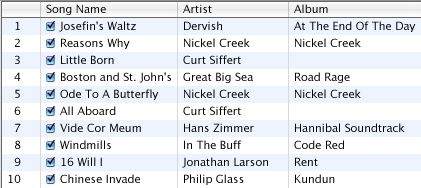
Eventually I'll figure out how to automatically get this on an About Me page.
Of course, each time I upload it, I overwrite the previous image so previous entries will be out of date as well. Oh well.
March 14, 2003
Investigating Fake Documents
Salon.com News | Senator wants FBI to investigate fake Iraq documentsThis is a good step. The article also contains details about what nuclear evidence is forged or in question (all of it).
Psychological Damage and Context Shifts
I was reading about little Ms. Smart and the theories that she might have been a bit psychologically influenced in her time away from her family. The theories aren't anything extraordinarily far-reaching, just a bit of that thought of the hostage bonding with their captors. There were a bunch of quotes from Patty Hearst about how when you're in a situation like that that rules your life, it's like all other truth gets stripped away and in order to survive, you can only operate within the truth that you are living.It just got me thinking that it sounds very familiar to what real life is like in general, especially in the struggles we have to evolve and move forward in our lives. I obviously am removing "scale" from the equation here, as a kidnapping is clearly more traumatic than missing a New Year's resolution. But the abstract similarity remains: Just as how Ms. Smart's lost time with her family is a tragedy, it's also easy for us to look back on our lives at our missed opportunities or the ways we sabotage our choices and free will and view those as tragedies.
But then once in a while you have these clear breaks, like Ms. Smart being returned to her family. Traumatic, but a freeing up of energy, a release, a rebirth of potential. But how do you get there?
I guess first it requires the recognition of a problem, or something that needs to change. But second maybe what it really requires is a context shift. Something to shake up routine perhaps, but even deeper than that.
What are the ways we can invite context shifts upon ourselves without inviting trauma at the same time? I heard an excerpt from Tony Robbins once where he described a technique where you imagine your bad habits continuing indefinitely, and also imagine your discontent with it growing indefinitely, until it just gets intolerable and you break (and finally get motivated to change). I really hated hearing that approach because it's too negatively oriented to me and to me it sounded like it was about simulating trauma and inviting self-hatred. Not everybody gets motivated to change from self-hatred, not everyone's self-hatred patterns end in an "Enough is Enough" statement.
I think this is simply where environment matters. I'm not convinced about travel because you always have to come home. I think there is more to be said for investing heavily in controlling and improving your living environment, from your living space to your social patterns to your network of mentors - everything you physically interact with.
People tend to measure their evolution in terms of what they can physically manifest. So it makes sense, really, that it is things on the physical plane that affect our ability to manifest.
I'm personally trying to become a bit more physically oriented. I've started redoing some of my apartment. I might be gearing up for my house search. I need to commit to spending more time investing in my social network, and I'd like to find a couple of mentors. What other main ingredients would there be along these lines?
March 13, 2003
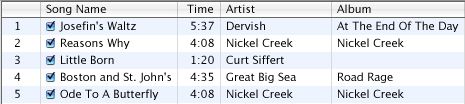
Current Top Five
Just playing around with my iTunes Top 20.
What If Bush Wins?
AlterNet: 'Bush Wins': The Left's Nightmare ScenarioExcellent points.
March 12, 2003
More Al Qaeda Curiousness
Remember my little conspiracy theory a few entries back? I expanded it here... basically that Al Qaeda guy #3 might not be all that he's cracked up to be.Well, it seems that story is building momentum. Here's an article from Reuters questioning Pakistan's motivations. A referring article mentions how Khalid Sheikh Mohammed was months ago considered a low ranking member and was reported to be dead.
Still doesn't seem worth a lot yet, but it has me more curious.
MacOSXHints article
I released my iTunes Playlist article to macosxhints.com and it got published today. Welcome to the new readers, hopefully some of you will stick around. If you do a search for iTunes off of my main page, you'll find some of my other playlist ideas.Pentagon Allegations
GuluFuture.com 4Dimensional News eZineAllegations that the Pentagon has threatened to fire upon media outlets of independent broadcasters in Iraq.
Not Even The British?
United Press International: Rumsfeld remarks hint at differencesNow there are hints that the U.S. might be fighting entirely alone, even without the British.
March 11, 2003
Emergent Democracy 1.3
Emergent DemocracyJoi Ito has released the latest revision of his paper. Important reading.
The War
Listening to
Every morning I get up
and I watch the war
...
It's the American Way
A New World Order
We hold these truths to be self-evident
...
Depressing Stat Of The Day
From this Salon article:According to a January poll conducted by Princeton Survey Research Associates, 46 percent of Americans thought most of the Sept. 11 hijackers were Iraqis. (Only 17 percent knew the correct answer: none were from Iraq.)
Iraq Blogger
Where is Raed ?Evidently this is an Iraqi citizen's weblog.
Bad Son! (II)
Salon.com News | Bush vs. BushA more detailed analysis with historical perspective.
Esquire World Map
Esquire has an article about forcing globalization on places that don't want it. I can't really write intelligently about this article right now, it just has me too upset. Just look at how his graph of world "problem areas" spreads out to cover the entire continent of Africa.Pre-Emptive... Surrender?
Sunday_Mirror.co.uk - SADDAM'S SOLDIERS SURRENDER - This is just so, so sad. (I'm not joking.)GM Foods, EU, WTO
AlterNet: Uncle Sam's Other War: Biotech vs. the European UnionAmerica is trying to bully (bully? loaded word? I honestly can't think of another way to conceptualize it) its way into the EU importing our GM food. It gives a good illustration of how the WTO works, as well.
Uninformed Opinions
Deborah (link removed on request) remarks about uninformed war opinion holders and I'm not sure if she was in part referring to me.Bush did it the UN's way and now certain members want to veto him and make us take this stand without the UN's backing. There is something wrong about that.
Okay, part of what is wrong about that is the part about "them making us take this stand." Huh? That's buying Bush's logic hook line and sinker. If Bush invades, that's for him (and all of us!) to take responsiblity for, not the folks that veto him. If you're thinking this makes us victims of the U.N. you've been buying into all that bullshit about the U.N. being made irrelevant if they don't do exactly what we tell them to do. France is on record as saying they are opposed to any resolution that would automatically trigger war. It sounds like they are insisting that the UN be able to pass a resolution declaring war if it comes to that. That doesn't seem unreasonable. Russia is on record as saying they aren't in favor of any resolution that would be impossible for Iraq to comply with. That doesn't seem unreasonable. Canada is in favor of a resolution that offers clear benchmarks for Iraq to follow, and the US is ignoring them. Russia and Canada's logic are along the lines of what I was saying in my previous entry - leave America's interpretation of Iraq's compliance out of it.
Go check out my link on Deliberative Polling - you'll see that a cross-section of the population became more in favor of a multi-lateral approach after delving beyond the latest CNN updates. Geez, even his father is.
Bad Son!
Bush SR criticizes son President Holy crap! Holy crap!!! (via damon)March 10, 2003
More Conspiracy Theory
Pakistan says it's on bin Laden's tailAt the news conference, the intelligence officials also showed journalists a grainy video purporting to show the nighttime raid on the house where they say Mohammed was seized [...] Most journalists at the briefing said the video looked like a reconstruction, which will fuel rumors that Mohammed might have been seized in a previous raid in another place.
Privacy for OS X
I ran across a couple of articles talking about how emails are technically less private than sending postcards, and considerably more dangerous. That plus paranoia about all the post 9/11 privacy invasions has me thinking a bit more about protecting my own privacy. Obviously I don't seem to care a ton about privacy given that I have this here weblog, but you know. There's that baked bean foot fetish I have that I don't want anyone to know about. So, I figured out how to get encryption going on my Mac.First I went to MacGPG's page and downloaded GNU Privacy Guard for Mac OS X 10.2.x (which is currently at version 1.2.1r2). I followed the directions in the ReadMe and verified the signature of the *.dmg file to match the signature posted on the website. Then I clicked on the GnuPG.mpkg package to install the software. The Basic Install is fine.
I also reviewed the optional instructions for IDEA encryption.
I installed GPGKeys off of the same page.
I installed GPGPreferences off of the same page. I initially wasn't sure because it referred to requiring 1.07 when I had 1.2.1 installed, but it looks like it worked fine. I now have a GPG Preferences Pane. It says my compatibility settings are "Custom".
I installed GPGDropThing and GPGFileTool from the same page.
Finally, I found the GPGMail Plugin for Apple's Mail program here and installed the extension.
Now I'm all set. There are a couple of extra icons I can put in my Mail icon bar, and there are also a couple of extra ones at the top of my Message windows as well. Now if I can find some people to also install the software, I can send encrypted email to them and no one else will be able to read the emails. Hooray.
And I just sent my first signed email to Damon, with my public key appended, so he has some homework.
Finally, here's my public key:
-----BEGIN PGP PUBLIC KEY BLOCK-----
Version: GnuPG v1.2.1 (Darwin)

mQGiBD1LG4IRBACaZeXcxos4fj7FXCixL5rtjIOoAoAJmsYYD/TvnB4Wh9XYerCh
oYVtd2fUR/djsR07zu+SNAzTNZraDMiT0iSLpaZv+dj7VZx2pIsSePLdZN3xOy7Y
HVUqykhoxczza9pimeggKlXhnuBkQ0vhVynLHWNOFwu+CPpuN0zhJgdSVwCggLDU
RvGRZG8cTOy8b2Ks7kdN84kD/i6wgzFUCZcqis8U7IbgfxQvV/u9NzUAJk25SrR3
LeOvAqRt62qoDDHBU4vH77VKxuAPxxvuKTEttCNC4WBrdegOtsVJo7yOIHybWpYX
HSJVuHl4HiyCsMI0FhfauuGRiCOzBBENBS5mvGD6FTUhzpsvg7tnj72Ha9LJUHwU
vW1NBACVp/3Y0hrdmgveEzYKgUH606prBXuPsOdEDVyiehwRoB33XXDaacfhU9xA
KrXdXyzbPtJUGcYN6z0FX/1YDE1s/V0a3sJ+xP8BuZSxgt3F8Msp3ccd93khkb18
VfcKFPHUnsjm4gHPQn0HcNfzNXbfrCIE1UxGTcTJObVK9bCPYrQ1Q3VydCBTaWZm
ZXJ0IChUaHVuZGVyLVRodW1icykgPHNpZmZlcnRAbXVzZXdvcmxkLmNvbT6IWgQT
EQIAGgUCPUsbggULBwMCAQMVAgMDFgIBAh4BAheAAAoJEC6sBkd7dA2yyX4AniF+
U0sSjGcfcsloH1uAeoV+KzdQAJ9UCqTT/Kv9CHZ0NzTRH09bTA0gD7kBDQQ9SxuG
EAQA3JEYMEI4cs5xHX91ppq8SIhtl7VFvUofwzodT8uZekG+lJaJFWDkbG0sgbUq
whQHOIl10HNrnSs4nyfDp5+bFhSM+BHwwtw7FV0zkQEadnw0GmSjd8AKR6ny8jFV
E0YThWEEiuhWwL50CkxyVYeIj97sMncAT8F+/H10tgeuinsAAwYEAJzTbE3lApaI
VsWllTqjQ0mlJVFTVXyMG35WvcsU3AkT8wGwiFjirCCGQc4ghGHR/cq/ROumuyxL
s3joEtmRolMZGXIuPf6VRPuH5qjd/XrwwzYr5XgOl25V9gnZ02jge5/rbEL2y7I7
J0VvnZSa7LcHZYwTqWKZyc/dDqJGjVpmiEYEGBECAAYFAj1LG4YACgkQLqwGR3t0
DbKgrACfagl40gSoBesRk/vy1b9bhC+2P58Anig/xTzlUR8I1su6YZn+1wLQXJAT
=Werj
-----END PGP PUBLIC KEY BLOCK-----
March 09, 2003
Refined Iraq Thoughts
In my previous Iraq entry I was trying to put my finger on what was bugging me about our approach. I have it now.The reason Bush has a credibility problem here is because he's putting on a charade, and people sense it even if they can't put words to it.
The problem is he's asking Iraq to prove that they have no weapons of mass destruction. Or to fully disarm, but the end result of that is that they prove they don't have the weapons.
This is a logical impossibility. Iraq will never be able to do that. It doesn't have to do with them being unwilling, it's simply impossible.
You can't prove a negative, unless the negative has a contrapositive you can prove the presence of. If you ask me to prove I'm not dead, I can do so only because I can prove I am alive. But if you ask me to prove I have never seen a hedgehog, or eaten ostrich, or run the 440 hurdles, I can't, because they have no positive opposite.
Iraq can't prove there aren't any WMD in their borders for this reason. They only way they'd be able to prove it is if they got a million satellites (that could see through concrete, lead, and into underground bunkers) to take pictures of their entire country all at the same time, at high enough resolution that they'd be able to positively identify every object as Not WMD.
The meaning of the word "proof" has been blurred here. Proof means that you don't have to rely on someone else's subjective interpretation for it to be accepted as true.
But no matter what Iraq brings forward, Bush can interpret it however he pleases. "That's not enough. I'm sure you're hiding more. Prove you don't."
This is why Bush has low credibility; it's transparent to some (at least translucent to others). He's so clearly trying to manipulate his way into justification for war.
For him to have credibility, he'd really have to do one of three things:
- Give Iraq something they would legitimately be able to prove
- Provide proof (see above) that Iraq has the WMD
- Make his case to the U.N. by pleading suspicions, track record, and history. Just friggin admit he wanted to go to war from the beginning and try to convince everyone he has good reasons.
There are plenty of other reasons, I'm sure, for me to be opposed to this whole mess, but this is the crust of it for me. He's false. I can't even judge the credibility of anything else he claims or says when he pulls this kind of crap that is just false.
(What's silly about this is that the U.N. diplomats, were they to read this, would probably roll their eyes and thing, "Duh, we're fifty steps ahead of you... this talk about the integrity of the U.N.? We're just trying to get another fifty million barrels out of the U.S. before we sign off.")
Emergent Democracy And Action
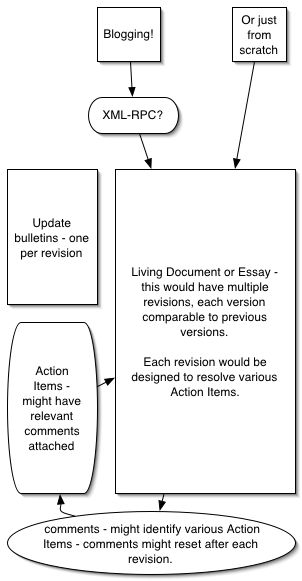
Joi Ito has been doing a lot of thinking about Emergent Democracy, and he's talking about translating ideas into action recently. This is really a key subject and coincides with an idea I've been toying with for a while that combines blogging with comments, action items, summaries, and revision diffs.Here's one of my early drafts. (Intended to be a public concept, so this is prior art so no one can patent it. Silly that should even occur to me, but for the recent Amazon weirdness.)
|
It implies having moderators (or perhaps community moderation) summarize collections of comments into ideas that are then submitted as action items. Document revisions resolve the action items, at which point comments can reset. Some variations can have the living document edited by the project manager only, others can have the whole community edit the document.
It doesn't have to be a document, either. I just imagine it in context of a position paper where a point of view is further and further refined.
|
March 08, 2003
iTunes Top 20 Smart Playlist Strategy
iTunes has one play-tracking limitation that, if fixed, would yield some very cool playlists: the ability to see how many times a song has been played recently. But there's no timestamp saved for each play; it just increments the playcount and records the last playdate.Nevertheless, it is possible to determine which music is recently popular and find your recently favorite music. I've made some new playlists that I believe improve iTunes' ability to accurately represent my real Top 20.
Right now my Top 20 has the following criteria:
- Five Stars, AND
- Last Play is in the last 2 weeks
- Limit to 20 songs selected by most played
However, I noticed that sometimes when playing randomly from all my five-star music, some of this music that was highly-played but not so well-liked anymore would still get played once in a while - as often as any other - and then jump back into the Top 20.
I realized that I didn't have a way to capture recently popular music, music that I'm currently obsessed with, and give them a chance to get more plays to catch up with the list. I also noticed that I was so intent on not giving the Top 20 a false advantage that I was avoiding playing from the Top 20 playlist, and wasn't giving recently popular Top 20 music a priority in my actual listening rotation.
So here are three new playlists I've devised to help me catch the music I actually love and give recent obsessions a chance to rise to the top.
Favs - Hot
- Five Stars AND
- Last Played is in the last 3 days
Favs - Recycle
- Five Stars AND
- Last Played is not in the last 1 week
- Last Played is in the last 2 weeks
Favs - Forgotten
- Five Stars AND
- Last Played is not in the last 4 weeks
I think this is a great system because now I can use my Top 20 as purely a reference, perhaps to export the playlist, or the occasional playthrough for friends. There is no need for me to listen to my Top 20 directly and risk falsely rewarding songs simply for being on the list. All my recent favorite music is now on my "Hot" list for rapid playcount climbing, and if any fall off before I'm ready, I can just promote them a few days later from the "Recycle" list. Overall, a much better system to find and reflect my current favorite music.
Current Top Five:
- Josefin's Waltz by Dervish (At The End Of The Day)
- Little Born by Curt Siffert (piano prelude)
- Chinese Invade by Phillip Glass (Kundun Soundtrack)
- Escape to India by Phillip Glass (Kundun Soundtrack)
- Ode To A Butterfly by Nickel Creek (Nickel Creek)
Bloxsom Comments
raelity bytes has "writebacks" (comments/trackback) enabled for Bloxsom. Even though I just recently switched to Movable Type, I'm thinking of using Bloxsom... perhaps only for my professional site. The only thing I'm not clear on is: Can an entry have multiple categories? Is it a matter of manual symlinks or is it simpler?Iraq Questions
I'm just going to write about one thing, because I've read a lot of articles and haven't seen this question asked, haven't seen someone discuss it, and it really pisses me off that I don't see anyone discussing this one, simple, overwhelmingly obvious question:How do we know if Iraq has disarmed or not?
Bush says, "It would be obvious." Or, he volunteers doublespeak: "We wouldn't because they'd be hiding them."
Asked a slightly different way: What's to keep Bush from saying that Iraq hasn't disarmed even if they have?
Or: If we're so convinced that they haven't, why aren't we offering proof?
It just comes across like, "We demand you to follow our standards, standards that we won't communicate to you so we have the option of telling you when you're not following them."
Not to defend Iraq or anything. But this approach doesn't exactly build credibility. All someone would have to do is ask the question to prove this whole thing is pretense. This has nothing to do with getting Iraq to voluntarily disarm. It insults everyone's intelligence, which is why Bush has no credibility. It's 100% impossible for Iraq to disarm voluntarily in Bush's eyes.
Deliberative Polling
Deliberative Polling is a method to show what happens to people's views after they have a chance to educate themselves on the issues, often through interaction with other participants of the polls.The executive summary is interesting - especially the part about British voting intention. Conservative and Labor both went down, while Liberal went up by 22%.
There's also a summary of a Deliberative Poll held between January 11th and 13th of this year, which is very topical. Lots of stuff about Iraq. In general everyone became more multilateral through the exercise.
A very convincing project overall.
March 06, 2003
Releasing Music
Alluvium is a "decentralized streaming media solution" that uses "warming download technology to accelerate downloads while simultanesouly decreasing the load on the broadcasting server".The talk is that they might be spidering for creative-commons-licensed music.
I've been thinking seriously about releasing my three a cappella tunes under a Creative Commons license.
Al-Queda Re-Election Campaign
For the conspiracy theorists:Think the nabbing of the Al-Queda #3 guy seems a little too pat? Read this article from the Asia Times, from last October, mentioning how this guy was already killed in a raid last year and how his family was interrogated. Read the cheerleading of the recent events. Read some more comparison of the recent story and other conflicting information.
So, theorists, why would this be staged? Well, there's a re-election coming up.
I don't seriously think that this is a big conspiracy, in fact this is probably my first attempt at connecting arbitrary dots to draw a strange picture. But it's freaky to think about.
And as for how I stand about guy #3? Mentally it sure seems like it's a huge win. I should be really impressed and happy, and really, I am. The grudging tone? It's from Bush having such horrible credibility now that it makes me suspect everything. I think it is plaguing the entire administration and government right now. Even if he might be suggesting something that makes sense, he has no credibility and other world leaders don't trust him.
I wonder what it would take for other nations in the world to get more heavily involved in our own elections? I mean seriously, it isn't President of the United States anymore. It's President of the country that controls every other country's foreign policy as well. Call a spade a spade. Shouldn't they have a say?
March 05, 2003
BitTorrenting Again
I forgot to tape 24 again... so I went to one url, copied a link, started up bittorrent, pasted, and now the episode I missed is downloading. So easy. Still stunned at what a change that is from how it was last year, hunting usenet for an uncut episode.I browsed around the BitTorrent site and he has a suggested donation of $5. That was a complete nobrainer, just sent it off.
Living Dangerously
Sometimes I pull into the garage, press the remote to close the garage from inside my truck so the door starts closing, and THEN turn off the engine.March 04, 2003
Top Blog Books
BlogStreet : Popular Books I find this fascinating. These are the top twenty books as counted by a blog utility. It just illustrates how the people that are blogging are a very different group of people than society in general. We're just slanted. But, this is a crazy cool top twenty list. I'd love to have all these books. Anyone want to buy me one? Well, I already have The Tipping Point and some of those blogging how-to books I might not want... and I've read parts of Stupid White Men... but the rest... sure!More Weblog Toys
BlogSnob is another foot soldier in the war against the power law. Basically it's a link trader through textads. For each page view on my blog, it yields an ad impression for the text ad of another blog. Which means that the ad for my blog will then show up on another blog's text ad. But. What's cool is it's not a 1:1 ratio. The less popular blogs get more ad impressions. To help balance things out. Good work.I'm testing it here and will soon put it on my sidebar if I like how it works.
Java Graphing
TouchGraph is an open source application you can hook into your database to get dynamic graphs of your data. Not sure I could use this for my todo application, but it sounds pretty cool.Stat Test
Blog Patrol has a stats server... I'm pasting in some javascript code to see how it works.
Apple Music Service
Mac Rumors reports about the new Apple Music Service - 99c a song in mp4, burnable to cd.First thing I'd do is buy all the songs in my current iTunes top 20 that I don't already own.
My Top 20 (eventually I'll have it on my blog) is: my top twenty five-star songs that have a playdate in the last two weeks, ordered by number of plays.
One of my main listening habits is that I play all my five-star music and then just skip the tunes I don't feel like listening to. This results in changes to the top twenty. And since I'm always getting new music, they'll get more recent plays, so filtering out music I haven't heard in two weeks enables new music to hit my top twenty. I think it's the best possible iTunes top twenty system.
Phone Call #483958
Ring..."Hello?"
"Hello?"
"Hello?"
"Stayvin!"
(beat.) "Hello?"
"Stayvin!"
"Hello?"
"Stayvin!"
(beat.) "What are you SAYING?"
"Stayvin!"
"'Stayvin'? What is that?"
"Is this Stayvin Babcock?"
"You have the wrong number."
"Oh, Ahhm sorry!"
click.
It wasn't until then I realized it was a southern accent. Gawd. Yay me. So have you belittled a southerner today?
Blog Comments
Jon Udell: Annoying habit #1 - Jon discusses comments in terms of both discussion boards and blogs.I find discussion boards kind of annoying because you have to look for them. You usually have to be in the explicit mood to have an opinion and share with a group of people, and then seek them out. When really comments are reactions.
But Jon mentioned that "per-item" comments annoy him and it made me realize they annoy me too. Comments aren't always in reaction to just one item, they are in reaction to a concept. I might post several blog items about a certain concept or category, and they all have comment forms. You'll notice that in several more popular blogs (grr) that conversations span several comment trees and it gets confusing really fast.
So I think what is needed is the ability to group blog items into a family that all have one comment board. When you blog an entry, you pick the comment board it is routed to.
All of this suggests to me another reason for a blog having more than one view. The only common existing view right now is reverse chronological. There are several other possible views, though.
One thing that will also become more popular and desired over time is a BlogSummary service where a collection several posts are summarized and people can read the summary.
Harry Potter Spoilers
HPANA - The Harry Potter Automatic News Aggregator is something I've been subscribed to for a while, and I'm unsubscribing today because they are infuriatingly irresponsible about spoilers. Today in my feed there was a headline that said, (censored) Hints at (censored)'s Death. It's common knowledge there is a death in book 5, but this was just stupid, stupid, stupid. Even if it was a red herring, I don't like that either.Update: - I had a pleasant conversation with Jeff, the editor of HPANA, and he explained that it is an automated service that doesn't have control over what spoilers are posted. That was unfortunately not obvious when I subscribed, and since most other services like this have editorial control, I wasn't really expecting it until after I was spoiled. It appears that he is developing a "No-Spoilers" mode - more details in the comment he leaves.
March 03, 2003
March 02, 2003
Working With IP
I wrote my earlier entry on patents and IP partially because I'm trying to muddle my way through my thoughts on a professional opportunity I have.I've written about quite a few ideas I have on the power law (search my blog to see), and I have a few more that are muddled enough that I haven't published them yet. In addition, I've written in the past about music technology and recommender solutions, summaries of which you can find among my tangrams.com writings here.
Anyway, one of the things I've been interested in is collaborative filtering. When I was more closely following the financial tipping thing that was being worked on as a result of Napster, I started talking to the guys that were running fairtunes.com, and it turned out that one of them started working with one of the known experts in collaborative filtering technologies. I found this really interesting and kept this expert as a contact.
As time has gone on I've found that one of my most central interests is in counteracting the power law. Whether it is through allowing a new musician to have a shot at supporting him or herself through finding an audience, or finding ways to have a wide variety of people's opinions equally weighted, or allowing news items from any source in the world to be distributed according to their worth, I want to be involved in breaking down barriers and allowing the movement of information, and have that information be visible according to its merit, and not simply according to the popularity of its messengers.
note to self: maybe popularity of messengers can be co-opted
Well. I recently wrote this expert about an idea I had. He wrote me back saying he was working on something similar. I have no doubt he'd be able to solve things I can't due to his statistical knowledge and training. He thinks I might have value as an implementor.
And that's where the IP messiness comes into play. I like my ideas. I've also written on my blog before that I have more ideas than I can implement. My compromise to myself there in order to keep my sanity is to publicize the ideas I have that I don't have the willingness or time to implement, just in case they might cause enough ripples to cause themselves to exist through other means. I could keep them to myself but that is idea suicide if I know I won't implement them. I could patent them and wait for someone else to implement them and then seek licensing, but that is just not what I believe - it is restriction of evolution rather than encouragement, and god knows we need to evolve beyond where we are now, and in a direction that encourages MORE freedom of thought, idea, and movement than we have now; not less.
So that should make my side easy, shouldn't it? Well, not so fast. Because it seems the only way this could work is for me to open myself up to the possibility that ideas *I* have would be restricted, and perhaps restricted even to me. They'd want commercial rights to ideas coming out of our discussions, even though my sole ideas would remain solely mine. And part of what would be mixed in would be various trade secrets and patents they have - implementation inventions (which I don't have a problem with), and restricted ideas (which I might). I might especially have a problem with restricted ideas if they then poisoned mine.
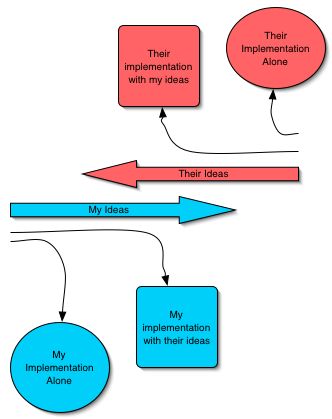
This is a gross simplification, but it's how I abstractly view it. For sake of argument we'll say that we are both working towards the same goal. For sake of argument we'll say that both circles are impossible, neither can meet their goals alone. For sake of argument we'll say that either one of our implementations are only possible if our ideas overlap.*
I believe and trust that their ideas are more well-developed than mine. They know I have an independent interest to develop my own implementation on my own time without being paid. They know it is currently impossible for me to reach my lower square without their help.
So far it appears their solution is to reroute me to work on their upper square in exchange for possible equity. I think, but I am not sure, that this means I will be restricted from reaching my lower square. Especially because, what if some of their ideas are a direct superset of some of mine? That almost certainly has to be the case. Wouldn't mine just get swallowed and wouldn't I be limited from pursuing them further because they'd be poisoned by the superset? That's the crux of this whole mess, the IP is viral. I don't think "possible equity" is enough to make up for that.
I'm still thinking about it.
* Obviously I could do my implementation by accumulating their knowledge myself through training and statistical study. They could also find someone else to help. They might also not be interested or find value in my ideas at all; and might only find value in my implementation skills.
Poor Kids
Children With Tourette's Syndrome See Harry Potter - Okay, I saw this headline and I snickered. Well, I squelched a snicker. But still. I'm so bad. But I also have a big heart. The blurb said that a doctor arranged the viewing. Poor kids, can't normally go see it because of the disturbances, you know. What a nice doctor. And the mental images have mostly subsided by this time, as well as the desire to hear an mp3 of the audience. And the wondering of if someone with Tourette's sitting in an audience with 199 other kids with Tourette's is really having a good time. I'm mostly over that by this time, too. So I decide to click on the link to read the full article. And I see the picture at the top, and that's really all she wrote, it was hopeless. I'm still laughing. Like Nelson from The Simpsons. I'm so, so bad.Intellectual Property - Prosperity or Preposterous?
"If nature has made any one thing less susceptible than all others of exclusive property, it is the action of the thinking power called an idea..."Law approximates intent. See my first three paragraphs here. Laws age. Intent is forgotten. Reality shifts, law is repurposed; applied to a new paradigm. Law becomes perverted.- Thomas Jefferson
I've been doing a lot of thinking about patents. Patents are for when someone comes up with an invention. It was for the inventor to have a limited monopoly on the idea behind the invention and restrict others from being able to use the idea. Jefferson was named head of the patent office in 1790 as a result of the Patent Act of that same year.
... which an individual may exclusively possess as long as he keeps it to himself; but the moment it is divulged, it forces itself into the possession of everyone, and the receiver cannot dispossess himself of it.Jefferson was inherently biased against any scheme that created a monopoly of an idea. He believed that ideas should be released to the public for the common good. He came to support the patent office because he found a way to reconcile its existence with his views on invention. His philosophy was to use the patent system to encourage invention, not to protect or restrict them. The utility of the patent office was to be of equal benefit to both the inventor and the general public.
Its peculiar character, too, is that no one possesses the less, because every other possesses the whole of it. He who receives an idea from me, receives instruction himself without lessening mine; as he who lights his taper at mine, receives light without darkening me.He agreed that inventors should have "full rights" to their inventions, but he worried about patent abuse, and the possibility of patents delaying the arrival of inventions to the general public. He insisted that an invention had to be useful, and not a repurposing of something already invented. He focused on application, not theory. He personally reviewed every patent application that came through the office while he was its head.
That ideas should freely spread from one to another over the globe, for the moral and mutual instruction of man, and improvement of his condition, seems to have been peculiarly and benevolently designed by nature, when she made them, like fire, expansible over all space, without lessening their density at any point, and like the air in which we breathe, move, and have our physical being, incapable of confinement or exclusive appropriation. Inventions then cannot, in nature, be a subject of property.
Jefferson became in favor of patents when he witnessed how the extra protection enabled inventors to feel safe in coming forward with their ideas.
So, time passed. The patent application procedure was made automatic, then was given more personal review, and was tinkered with several times over the centuries. It didn't scale well. Today we've got a system with crazy patents like a method to shine lights on the wall so cats will chase them. A slashdot search for patents will yield pages of questionable "inventions".
Part of the problem is software patents. To be fair, software patents aren't themselves the problem - software can legitimately qualify as an invention. But "software" is too abstract to be legalized as a patent family. Software is language. Sometimes language can be a song or a poem. But other times it can be a label or a description. Software can be an invention, but it can also be merely an idea. Ideas are not always inventions.
This blurring distinction has led many people to protect mere ideas, even abstract ideas, as intellectual property. A system to link documents to other documents. A system to participate in an online discussion board. Oftentimes these patents are extremely similar to other public implementations that have been in existence for years.
Questions for musing:
- Are patents inherently bad? Compare and contrast today's patent philosophy with the original intent of protecting inventors and contributing to public utility.
- Should an idea unattached to device, implementation, or manifestation be enough to make you any money?
- Despite being head of the patent office, Thomas Jefferson never applied for a patent for any of his inventions. Did that make him unwise? Would it make him unwise today?
PreEmptive Tangent To The Next Entry
One of the things that sucks about blogging is the fact that when I care about something, I feel like I'm rephrasing thoughts I've already read before, but in a way that makes sense to me. What ends up happening is that for the audience of mine that is interested in the same subject, they've already read what I'm writing about, and probably from sources that are more well spoken and better organized than I.One of the strengths of blogging is that the strength of personal connections - meaning, the connections that don't have to do with common topical interests, but other more human connections like family, friendships, common experiences - yields an idea virulence (word?) that wouldn't otherwise occur. I don't know a damn thing about julienned carrots but if my buddy raves about them on his blog, it makes a ripple. He wouldn't rave about them directly to me because I'd smack him, but I give him more room when I read his writings.
March 01, 2003
Life Maintenance Space
See, I've got too much crap in my office right now. I want to clean it up. I use my office to work on projects and clients, and also to do research.But it's too full because I've been so busy, and because I'm not organized enough to have a perfect place for everything. Things are starting to pile up like health insurance claim forms (somewhat work-related since I write them off), and brokerage statements (which host my work-related retirement accounts), etc. I haven't scaled well.
So I start thinking in terms of themes. And really, I feel like I've got my Life Maintenance too mixed in with my Work Stuff. I've got course catalogs mixed in with client notes. So I'd like to separate it. I thought about having a separate life maintenance space, where I'd hook up my laptop to be able to pay bills, do Quicken, keep track of home organization stuff, and free up my office for just work stuff.
But here's where real life sucks in a way that databases don't. I can't multi-categorize. See, some of my life maintenance stuff is clearly work stuff. Like, where do I keep my business checkbook? I first thought that would go into my office. But then, what about my business receipts? This is where it gets tricky. Does all business financial stuff go into my new Life Maintenance space? Or is my Life Maintenance space more for purely personal matters? Grr. I don't know how secretaries do it. I hate these kinds of choices.
I guess I just need to pick one. I'll say all financial stuff, even business financial stuff, would go to my Life Maintenance place.
But then. What about invoices? Etc. You can see my problem. See, I'm not messy because I'm a messy person. I'm messy only because my organizational standards are so impossible in the real world that I just spread everything out into a spectrum to approximate what I need. It's actually extraordinarily organized, and it's not my fault that the real world can't handle it.
Patent Law Solution
What if you or your corporation could only be awarded a patent if you were 50 employees or less?Just brainstorming. There's obvious stuff that doesn't work, but the intention is to protect the rights of the inventor, not a massive behemoth patent-making machine.
Davos Reactions
damon wright | administrivia: Davos: WEF This is a fascinating email that Damon links to (three links downstream).Then I saw an even more fascinating discussion here.
In summary, Laurie Garrett attended the WEF, wrote a flippant email to her friends with fascinating and disturbing content about the world stage of political leaders and what they really think and say, and it got forwarded everywhere. The lawmeme article bemoans the fact that someone wrote something perfectly suited for what email is all about, and then because of other qualities of email (like how easy it is to forward), got burned, and will now no longer be using email for a task for which email is perfectly suited.
Here's what I think about that: Big Deal. Maybe Laurie Garrett will stop sending these emails to friends. Big Deal. She falls away from the new reality because she can't hack it. Someone else replaces her. The information flow will still happen, the information will still get out, the boundaries between the general population and the conspiratorial truths will continue to break down, information will continue to be shared to anyone regardless of their class or political beliefs. That's just the way it is. The people who can't hack that are just making themselves irrelevant.
Political Leanings
The Political Compass says that I am a liberal libertarian.It's a pretty cool test. I wouldn't mind seeing the results of some of my friends. Damon, I'm betting you'll be a couple notches to the right of me and maybe a couple notches above, but not as much. I'm betting Tamara will be further to the left and much more authoritarian. The rest of you? I have no idea. Take the test and leave your results in the comments.
Plumb
Jonatha Brooke