January 05, 2005
Contested Election
Something pretty damn big might happen tomorrow.
The press will roll its eyes because they don't know how to deal with it.
But for the first time since 1877, the presidential election may be contested.
In 2000, they were unable to find a Senator. This year, word is they have one.
Now what happens if that happens? In terms of cold hard calculus, maybe not much. Others have more details, but I believe the two bodies of Congress will retire and separately decide whether to accept Ohio's slate of legislators. The GOP has the clear majority in both bodies.
But beyond that, what happens is what we make happen. There were very bad things that happened in Ohio that the GOP is trying to keep quiet, and they've broken the law to do so.
December 02, 2004
Washington Governor Deadline
Daily Kos :: Breaking news - WA recount update - In the state of Washington, which is something like five miles away from me, the Governor's race currently has a margin of 42 votes, with the Republican in the lead. A hand recount can be held, where several ballots that are only examined in the case of a hand recount (which is ridiculous) likely benefit the Democrat.
However, they need to make a $750,000 deposit by close of business today in order for it to happen. They only have $500,000 so far. Otherwise, the Democrat will concede.
So if you'd rather have a Democrat hold the governorship in WA, make your donation through MoveOn, here.
Update: Correction, it's end of day Friday 12/3.
Update: Hey, they did it!
November 26, 2004
Apportionment And The Electoral College
Regular readers of this site might know of my nuanced opinions regarding vote reform and the Electoral College. I'm not one of those people that believes that the Electoral College should simply be disbanded, because there's something about the logic behind the E.C. that I find consistent with the basic approach behind the U.S. Government.
Basically, each state is given an Electoral Vote for each Representative and Senator that the state has. Much in the same way that Congress is a compromise between popular representation (Representatives) and regional representation (Senators), the Electoral College weights the popular vote by the region the vote comes from.
I agree with that general approach. I think our national interests deserve to be represented, and our interests are not just reflected by our population, but by the geographical environment of our resources. If a vast area of the United States doesn't have much population, I don't have a problem with that population being given a bit more voting power to represent the interests of that area, and of the culture that the area creates.
That said, the way we are choosing to reflect that weighting is pretty messed up. One way in which it is messed up is the winner-take-all of our elections. For each region, 51% gets everything, and 49% gets nothing. The thought is that on a grand scale, these various wins and losses cancel out, and to a large degree, they do. (The other flaw of winner-take-all is that if there is a consistent voting bloc that is always below 50% in any region, they will always be unrepresented.)
The other way in which this is messed up, which I haven't explored much yet, is in this whole subject of apportionment.
This whole subject is kind of dense, and it's easy to take a tangent and discuss gerrymandering, but what I'm referring to in particular is how we decide how many Electoral Votes each state has. What affects the number of Electoral Votes is how many Representatives a state has (each state will always have two Senators).
The number of Representatives is figured by the census we have every ten years - that requirement is actually in our Constitution. This site has all the details.
The main question about apportionment is the balance of power between Senators and Representatives. And what makes it all so maddening is that this is one of those silly examples where there's no longer any valid rationale behind the technique we have now.
Basically what happened is that there used to be far less representatives in the House than the 435 we have now. The government set the House at 435 members in 1941, and it hasn't changed since.
It's basically the story of two warring percentages.
First is the number of voters per representative. There are definitely good reasons to keep this consistent when you're dealing with popular representation. Right now there's an average of almost 650,000 voters per representative, when it used to be far less.
But the second percentage is the number of representatives per Senator. As more representatives are added to the picture, the Senators don't increase in number. This means that as the number of representatives increase, the Electoral College becomes more and more reflective of the popular vote, since those two extra Senatorial EVs count for less and less in the ratio over time.
I came across this study which is a fascinating exploration of the 2000 election. It shows that the result of the 2000 election depended on the size of the House of Representatives. If we had had the exact same vote in every state, but the the House of Representatives had had 492 Reps instead of 435 Reps, Gore would have won.
If we had kept the same ratio of voters/rep that we had had in 1941, then we would have over 800 Reps in the House, and Gore would have won the election easily. This is the main point of the paper. The implication is that as time goes on, election results are going to be less representative of the popular vote than it would have been had we not fixed the House size in 1941. Less and less over time.
But it's interesting because that isn't really the raw deal that it sounds like it is. It overlooks the second percentage - the number of representatives per Senator. There are good reasons to not allow that number to degrade over time, at least not in terms of voting power. I don't know the the reasons behind the 1941 agreement, but much of it could very well be because they didn't want states to lose their Senatorial weight in the Electoral College.
The paper shows a really interesting graph showing how Gore becomes more and more likely of winning as the size of the House increases, which seems very odd at first because it seems like the size of the House is really the only determinating factor. But it's not as exciting as that - the only reason that graph works is because the Electoral College vote went one way and the popular vote went the other way in 2000. As the House increases and the Senate remains the same size, the simple explanation is just that the Electoral Vote count will become more and more reflective of the popular vote. And Gore won the popular vote. So it doesn't really point out anything all that revolutionary.
There's a good reason for keeping the number of Senators at 100 - it's a nice round number, and we don't exactly want the Senate to become even more unwieldy. And a Senator's power is not actually going to decrease as the House increases in size - it actually would probably be the average House member that would have less public recognition due to the added numbers. But, in terms of Electoral College voting power, there's good reason to protect that ratio. So how do we protect it, while also letting the House expand? What's the way to compromise between both warring percentages?
One thing is that you could keep the 4.35:1 ratio of Rep EVs to Senatorial EVs, but then allow the number of Reps to expand again. One way I can think of is to concede that every state is allowed to have at least one representative, so award one representative to the smallest state in the Union - Wyoming - and then use its population as the number of voters per rep. Apply it to the rest of the nation to get the number of Representatives. According to the 2000 census, that would be around 568 Reps instead of 435. Then we apply the 4.35:1 ratio - we'd still keep 100 senators, but we'd add in another 2.6 Senatorial EVs to each state.
People that argue about the Electoral College have to be careful about how many different arguments they are conflating. It's a very complex issue. The issue of how many representatives we have is different than the issue of how important the popular vote should be. There's very good reason to support there being more representatives even without changing the tension between the popular-weight and regional-weight of the Electoral College.
Update: I guess I'm not done analyzing this one yet, due to this quote from this article:
When [the Senate] was set up, there was a nine-to-one imbalance in voting population between the largest state, Virginia, and the smallest, Delaware. (Counting slaves, Virginia's edge increased to 12 to 1.) Now it's nearly 70 to 1 (California versus Wyoming), making the Senate our own equivalent of the United Nations General Assembly as a forum for overrepresented small states.
They're actually arguing that the Senate itself gives too much relative power to the small states compared to the early days, but does that also carry into the Electoral College? Hmmm...
November 24, 2004
Fraud! We Lost! Fraud! We Lost!
I've written before about the argument the left is having in trying to reconcile the results of the election.
As is the case with most arguments, the problem isn't so much the content of the argument, but the emotion behind it that isn't being admitted.
In the red corner, you have the "Fraud!" folks. There's definitely a wide swath of these folks, from the people that are methodically going through elections data and holding them up to rigorous standards of truth, to Peter Smith on the other end of the spectrum. Many of them hang out in the diaries at Daily Kos, and Democratic Underground.
In the blue corner, you have the "We Lost!" folks. There's a wide spectrum of them, too. These are the people analyzing what went wrong, and what we need to change to have more of a chance in the future. I'd count myself in this camp, along with the folks over at MyDD.com and most of the main page columnists at Daily Kos.
There's an argument going on between the two camps. Many of the "Fraud!" folks believe that the "We Lost!" folks think that all the election irregularities should be swept under the rug. Many of the "We Lost!" folks believe that the "Fraud!" folks are certain that we actually won the election. Both sides believe the other side are going to throw away any hope we have at winning future elections.
What are the emotions behind it? Well, the "Fraud!" folks see the "We Lost!" folks as being defeatist, for not paying the appropriate attention to the irregularities. They feel justified in opposing them because they are opposing defeatism. When actually, the "We Lost!" folks merely believe that it's important to accept a reality of losing before you can lay the groundwork to win again.
And, the "We Lost!" folks see the "Fraud!" folks as being in denial. They feel justified in opposing them because denial is embarrassing when you're witnessing it from the outside. When actually, the "Fraud!" folks are right to be centrally concerned about vote integrity, because of the opportunity for future fraud.
What's really sad is that both side's judgments fuel the problem. The "We Lost!" folks hate being called defeatist, and being called defeatist plays into their view that the "Fraud!" folks are in denial. The "Fraud!" folks hate being dismissed as they have been dismissed, and know very well that people are rolling their eyes at them, and it plays into their views that the "We Lost!" folks aren't taking their concerns seriously enough.
And so of course, both sides end up being a bit poisoned. It is no wonder that the "We Lost!" people want to stop thinking about election irregularities entirely. And in turn, it is no wonder that the "Fraud!" people start to wonder if more things are being swept under the rug out of mere expedience. Which further reinforces each side's judgments, etc.
What is the truth?
Well, let's go back to logic class. Remember sufficient and necessary conditions? If you have a desired outcome, there are conditions that need to be met to bring about that outcome. Some are sufficient conditions - enough to bring about the change. And some are just necessary conditions. Ingredients and pre-requisites for the outcome, but not enough by themselves.
The fact is that if our desired outcome is a Democratic win, both camps in this argument are defending necessary conditions, and neither are sufficient conditions. We can fix the election irregularities, but if we haven't changed the party, it's moot. And, we can change the party, but if the fix is in, it's moot.
It is interesting because people have been trying to make this point, but it has a very labored feel to it - usually with underlines, capital letters, and a metaphorical gasping for oxygen. It feels similar to how people labor to make the point that they are anti-war, yet still support the troops. There's an implicit acknowledgment that two points of view are incompatible, when that acknowledgment doesn't even deserve to be made. Of course they're compatible.
It's the same here. Of course we need both. That's not just equivocation. It's not just, "Can't we all just get along?" They're both necessary ingredients for political survival.
That said, a bit of a love-in wouldn't hurt.
Miscellaneous Department
- NBA Brawl: Interesting petri dish. Mix of conditions conducive to a riot, and deliberate choices. There were two triggers, the fan who threw the drink, and Artest going to the stands. Who is more culpable? Different standards. One is an awful, stupid action, and one is an awful, stupid overreaction. Neither is an excuse for the other. That said, while I don't find much of a defense for Artest, I find something hypocritical about the NBA's approach in this whole thing. It's like that kind of behavior is praised as "intensity" and "competitiveness" right up until the very point that a fine or suspension is meted out, after which everyone backtracks and reinterprets. That kind of double-counting isn't doing anyone any favors, and until the NBA takes actual preventative steps to keep these conditions from happening, it's going to be more and more common. The same goes for fan behavior.
- Matthew Shephard: Some sort of 20/20 investigation coming up on whether his killing was really a hate crime. Now, I'm opposed to hate crime legislation. On principle, I think it's too easily abused legislatively, and uncomfortably close to thought legislation. Actions should be prosecuted. If someone's hateful impulses lead to a more vicious crime, than that viciousness will be readily apparent as actions and should affect stiffness of the penalty. But. If this is really just about whether or not it was a hate crime, that dialogue is hardly the result that will come of the 20/20 investigation, and they know that. It just gives bigots reason to feel justified, and it doesn't do anything to mute the horrible details of the crime. It's a completely pointless post-conviction investigation on behalf of the murderers. 20/20 had a huge investigative and marketing budget for this, and when I compare it to the good that could happen from spending that money on investigating DNA results for death row prisoners that might actually be innocent... it's a pretty sickening choice that ABC is making.
- Exit Polls: Freeman has released a revision of his paper that I've written about several times here. The revision reduces the odds (the degree of strangeness of the exit polls) from 250,000,000 to 1, to 650,000 to 1.
- Ohio: The provisional ballot count is ongoing. Kerry's hail mary shot at flipping Ohio is all but gone - Bush has already gained almost 30,000 provisional ballots out of 155,000. The previous hypotheticals that had Kerry pulling it out assumed Bush would get less than 20,000 provisionals.
- DNC: I kind of like the idea of Dean being chair, but I've never been quite sure whether the whole bottom-up house party thing was more of a Dean thing or a Trippi thing. If Dean doesn't get it, he can still do a lot of good at DFA. But the chair will need to be someone who can help put together regular local community meetings based on the precinct level.
- Congress: We're already seeing more obvious strain between the two wings of the Republican party. GOP moderates are being frozen out and subjected to wedge votes all over the place. My fantasy is a mass exodus. We're not there yet, though.
- Future Elections: Nationalize the race. Nationalize. Nationalize. Rising tide lifts all boats. Environment can be used to appeal to farmers, ranchers, hunters. Start talking about truth again, as opposed to being conned. It all starts with trust and credibiity. Attempt to represent those that won't vote for you, because: it's the right thing to do, and it reduces the intensity of their opposition. Do it without compromising core principles. Focus on education - not just the school kind, but actually educating the voters.
- Thanksgiving: Honestly, it's not my favorite kind of food. And I'm not much for structured gratitude. Spontaneous is better for me. So, I'm looking forward to having the next few days off. I'll get to do more work on my film score, and plan out some future projects. Maybe I'll check out the GRE and see how dumb I've become.
November 19, 2004
Mystery Pollster and Exit Pollster Explain Polls
The Mystery Pollster covers the Freeman Paper. He knows a lot more than I do and I had a couple of things wrong, but it's a good read. He was in direct contact with the exit pollsters.
Finally, I understand completely the frustration of Democratic partisans with the election results. I'm a Democrat too. Sure, it's tempting to engage in a little wishful thinking about the exit polls. However, to continue to see evidence of vote fraud in the "unexplained exit poll discrepancy" is more than wishful. It borders on delusional.
Also:
So to summarize: Absent further data from NEP, you can choose to believe that an existing problem with exit polls got worse this year in the face of declining response rates and rising distrust of big media, that a slightly higher number of Bush voters than Kerry voters declined to be interviewed. Or, you can believe that a massive secret conspiracy somehow shifted roughly 2% of the vote from Kerry to Bush in every battleground state, a conspiracy that fooled everyone but the exit pollsters - and then only for a few hours - after which they deliberately suppressed evidence of the fraud and damaged their own reputations by blaming the discrepancies on weaknesses in their data.Please.
Finally, someone scored an interview with Warren Mitofsky. Excerpt:
I'll add, though its somewhat public knowledge at this point, that Warren agrees with the conventional wisdom explaining how certain bloggers reached the wrong conclusions. The data that was reported on election day had not been "weighted" for turnout yet. Once an accurate projection of overall voter turnout is made, the raw data that the exit pollsters collect is plugged into a complicated methodological system that I won't begin to pretend to understand. The point is, though, that a sort of "correction" is made to the raw numbers that everyone saw on Wonkette and other sites. The bloggers who ran those numbers either didn't know about the system of "weighting" the exit polling data, or didn't bother to point it out.
In short, we're waiting on the explanation for the 1.9% Kerry bias in the exit polls, but there are very reasonable theoretical explanations for it - which means we're nowhere close to having reasonable cause to believe the exit polls prove fraud.
November 18, 2004
Cool Electoral Map
This is probably the coolest electoral map I've seen so far. It's a map of each county in the United States, expanded or compressed to represent the population in the county, and it's blue/red spectrum represents how much it went to Kerry or Bush, respectively.

Kind of seems like a fantastical Democratic animal being restrained and almost overcome by the ropes and cords of conservatism.
There are plenty of other maps where that comes from.
November 16, 2004
More Election Denial
I came across this study, originally titled "Irrefutable Evidence: Ohio Election Rigged".
What he does is he takes a county, averages the votes that the Democrat and Republican got over the last four elections, declares it a "trend", and then compares how different the total was this year from that average. If it's over a couple percentage points, then he says that is irrefutable evidence of fraud.
I'm not going to go into the details here on how stupid that methodology is. I think I can safely assume that most of my regular readers can figure out that an average is not a trend, and that voting patterns don't follow those expectations.
But I decided to go ahead and explain to him why the study was flawed. It's all there up on his weblog - you can go read it and see the argument I lay out in the comments.
After his first couple of responses, it was pretty obvious that he wasn't going to be receptive to the possibility he was wrong. Under normal circumstances it would have been best to just roll my eyes and move along. But I wanted to see what would happen if I just doggedly kept trying to prove why it didn't make sense.
His reaction was pretty priceless - he then banned my IP address so I couldn't comment on his weblog anymore.
Another really great example of the kind of post-election denial that is among the left these days.
There are plenty of legitimate election issues to be upset about as Democrats. This study isn't one of them.
For an exploration of some of the worthwhile issues, please visit this wiki page of Ohio Irregularities. I've been the main maintainer of the site, and there is a lot to follow up on. One study that is begging to be made is the one that compares how many voters per voting machine there were in Democratic precincts versus Republican precinct. That's where you can get real evidence of disenfranchisement.
(Given that other folks on that site are upset at me for being too much of a skeptic of these election studies, that should prove that I'm not some sort of Republican plant. I guess they're too lazy to read my archives.)
Update: I actually made a math error in my last comment on that weblog, by looking at the variance of vote growth for each side, rather than the variance of the vote total compared to the "projection". However, the error doesn't change the fact that the study is silly. Here are the numbers for Mercer using the exact same math that Peter Smith uses:
Variance from '88 to '92:
Dem: 16.7%
Rep: -7.45%
Variance from '88 + '92 to '96:
Dem: 25.42%
Rep: -12.63%
Variance from '88 + '92 + '96, to '00:
Dem: -18.29%
Rep: 10.31%
So, you can see that Peter Smith's insistence that a variance of over 4% being fraudulent is completely silly. Unless you believe that Clinton committed gross fraud to beat Bob Dole.
By the way, Peter Smith also deleted my trackback that appeared on his blog, so that people wouldn't see the link over to here. :-)
November 12, 2004
Exit Polling, Continued - Freeman Study
For an excellent illustration of the exit polling controversy, as well as of the struggle for "political oxygen", check out this thread over at daily kos, and skim the comments. It even includes a discussion of whether fraud skeptics are republican plants.
The thread is about another study that supposedly shows how unlikely the vote count is compared to the exit polls. The study, by Steven F. Freeman, PhD of University of Pennsylvania, puts the odds at 250,000,000 to 1. It's misleading for many of the same reasons as the other study I discussed in my last entry.
Now, for the political oxygen part. One way to create more oxygen is to just agitate and create an incredible stink. That's the method I chose - halfway down the comments, I go ballistic on the community, shouting in all caps "THIS STUDY IS BOGUS!!" and writing in very short sentences.
It definitely got a lot of attention. People accused me of overstating my case, and they were right. And yet, I stand by the content of what I said, and given the same situation, I probably would have said it the same way. At least until I figure out a better way. But I think a qualified, reasonable listing of facts would have been glossed over and dismissed by the community.
People started making more mention of "Tunesmith's comments" in the rest of the thread, and people started requesting that the discussion be brought to the study author's attention. The author of the study has since made it known that while he received hundreds of email responses yesterday and about twenty calls from the press, he read the discussion, and is going to revise his study.
November 11, 2004
Exit Polling - David Anick
A lot of the screaming about the election is due to the gap between exit polling and the result of the election. There is talk about some mathematician named David Anick completing a study that says that the variance between the exit polling and the election result had a 1 in 50,000 chance of occurring.
First, please note: Being a mathematician does not mean you know how exit polling works.
I'm really skeptical of that study, for one reason: it uses the 4pm exit polling data.
Exit polling uses stratified samples, not random "representative" samples. Â The numbers are useless until you have the end-of-day turnout figures to apply to the exit polling, to balance and normalize the numbers correctly. In other words, they are supposed to be wrong in the middle of the day, and they are designed to be "corrected" (re-weighted; normalized) at the end of the day. It just doesn't make statistical sense to create a study directly comparing unweighted mid-day exit poll data to the final result.
Political campaigns and the media look at the exit polls during the day just for really inexact indications. Â But it's bogus to treat mid-day exit poll data with the same accuracy that we'd treat a telephone poll that uses random samples. Â The mid-day exit polls are less accurate, not more, because the exit poll samples are not random, evenly distributed, or representative of the voting population.
It is so fascinating to make this point over on the political discussion sites and experience the resistance to it. Huge tangent here, but it has me thinking more and more about "political oxygen", and what conditions need to exist for a population to be open to a truth that is different than their conventional wisdom. Or, how to create those conditions. We've got people painstakingly posting facts and conclusions over there, and being called Republican "plants" in response.
November 10, 2004
2004 Voter Fraud
I've had some people I know start to ask me more about voter fraud.
First, I think it's a good thing that this is getting into the news cycle. There are a lot of problems with our voting system that need to be corrected. The worst problems in 2004 had to do with the lack of voting machines in Democratic precincts, leading to lines as long as nine hours. And that was with a less than 60% voter turnout. If people are motivated about protecting the right to vote, the best thing they can do is volunteer to become poll workers, and become active in the races for Secretary of State. Next is to lobby your representative to support HR 2239. I don't think Wu is signed on for that. Blumenauer might be. And, demand that voting machines have paper trails - not the kind that give a receipt that you take with you, but the kind that you examine and is then turned into the ballot box.
Now, as for the 2004 race. There's a lot of confusion about this. There have been reports of incompetence and of mistakes. That's not the same thing as fraud. They found out that 4,000 votes had been wrongly given to Bush in Ohio. That was an easy find and it was guaranteed that people would find it. It was a mistake, and not fraud.
Fraud is someone deliberately changing Kerry votes to Bush votes (or vice versa), or deliberately giving extra votes to Bush (or Kerry).
There is currently no evidence that fraud led to Bush winning when he otherwise would have lost. For that, you need to not only prove irregularities (which we have, and which every election has), but also someone doing it on purpose (which hasn't been discovered), and most importantly, it happening on a scale that would affect the election. We definitely don't have that.
People are looking for that. I support the search. We haven't found it though. So don't get your hopes up.
Now, as for Kerry's chances to somehow get the election back. The only hope is in Ohio. It's the only state with a less than 5% margin of victory that would make a difference in the election.
Kerry's margin is about 134,000 votes. Some absentee ballots may not be counted, we don't know how many. Absentee ballots usually go for the Republicans. There are also provisional votes, about 155,000 of them. Provisional ballots are cast when the poll worker can't find the voter on the voter rolls for their precinct. Ohio has a law that says that if someone casts a provisional ballot in the wrong precinct, the ballot gets thrown out. Many of these ballots will be thrown out. The rest of them might very well lean towards Kerry.
If a recount is requested, then 90,000 overvotes can be examined. They are like Florida ballots - dimpled and hanging chads.
Assume there are no really weird surprises left. Here's one best case. Say absentee ballots are 50/50, leaving the margin the same. Now, say that 15% of the provisional ballots are thrown out, leaving 131,750 of them. I've heard reports saying that 85% of the Ohio provisional ballots went to Gore in 2000. If that sticks, then 112,000 would go for Kerry, and 19,750 would go to Bush. That would knock the margin down to 40,000 votes or so.
Now, that isn't enough to trigger a recount automatically. I've heard that the needed margin would be 19,000 votes. But, a candidate could request a recount anyway. At that point, the spoiled ballots would come into play. Let's say that 30% of the ballots truly are spoiled, which seems conservative. That leaves around 60,000 ballots where you could determine intent of the voter. That would mean that 50,000 of them would have to go to Kerry, and 10,000 for Bush, to tie the race.
Kerry's concession wasn't legally binding. If some more surprises turn up - for instance, more lost votes, or actual evidence of fraud, you can bet he'll be back fighting for the presidency. But they have professionals on board, that did more to work for the presidency than the rest of us ever did. They looked at the numbers and decided that the votes they needed to win just weren't there. I trust their competence.
November 09, 2004
Electoral Power Continued
I've written before about a study I completed that shows how much electoral power each candidate had through the final sixty days of the campaign and election day.
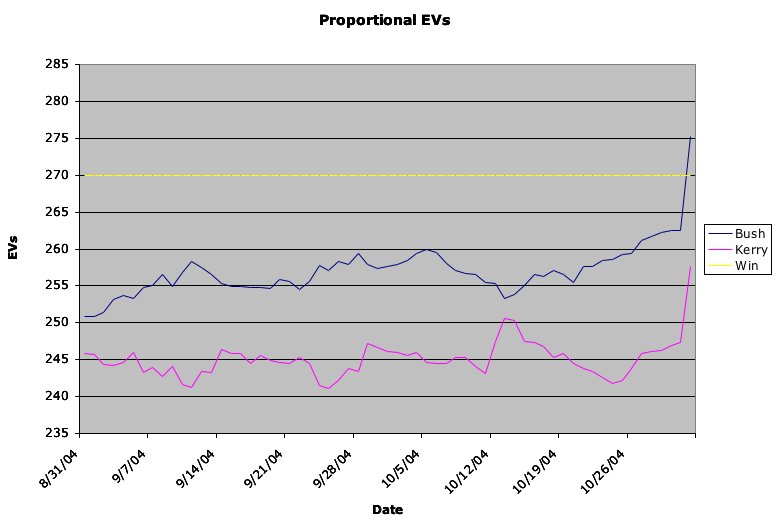
(Click to enlarge.) Election day ended up with Bush having about 275 EVs worth of electoral power, and Kerry having about 258. The spike at the end is all the undecideds breaking for their candidate, compared to the polls.
The way I figure this is by giving each candidate a portion of every state's electoral votes, by how much support that candidate had. This makes every state award its EVs proportionally, and is a more accurate gauge of the actual support each candidate has - it represents the underlying physics of the Electoral College.
One of the most common points people have made against this technique is that it exaggerates the power of rural voters in safe Bush states. The critics say that since these small states have so little population, then the Bush voters in this state are given too much weight, so this method exaggerates Bush's level of support.
It is true that the Electoral College gives rural states more voting power than the most populous states. But in order for that critique to have merit, it would have to mean that this study gives more of an advantage to these Bush-state voters than the Electoral College does itself.
The best way to gauge this would be by looking at the safe states. If this were true, my method would exaggerate the Bush support in the safe states.
So, I took a look.
We can consider the safe states to be the states where the margin of victory was greater than ten percentage points. Here's how those states added up in the Electoral College:
Bush: 183
Kerry: 146
Now, let's look at how those states would have played out had we awarded the EVs proportionally:
Bush: 171.3
Kerry: 154.4
So, that should be enough to smack that criticism down. Let's look at it again if we look at the states was greater than 5%. First, the Electoral College:
Bush: 249
Kerry: 183
And, the proportional study:
Bush: 223.2
Kerry: 204.5
The reality is that the Electoral College exaggerates Bush's support even compared to this proportional study. It's actually pretty obvious once you think of it - since there are so many small states in the Electoral College, of course the winner-take-all nature is going to work in Bush's favor. In this election, Bush actually outperformed the base numbers due to the inefficiencies of the Electoral College, much like how Gore outperformed them in 2000. My graph, above, actually understates the gap between the two candidates. The truth is that Bush actually had more electoral support than Kerry all along, and we have a ton of work to do before we can have an even chance of beating these folks consistently.
November 07, 2004
Electoral Analysis In Hindsight
I have a depressing analysis to share. I've done a new study on the 2004 polls, and it shows that we were fighting an uphill battle the entire campaign, and that the odds were against us winning all along.
The reason I'm sharing it is because I think it's highly valuable in illustrating just how much work we need to do in order to become competitive again as Democrats.
This builds upon earlier work that I have done. A few months ago, I went back and analyzed the 2000 vote and showed that Bush actually had more electoral support than Gore.
A few days ago I showed that even if we were able to steal the 150,000 votes to win Ohio, Bush still had more electoral support in 2004.
The way I did this is that I checked each state's results and awarded each candidate a portion of that state's electoral votes, by what percentage the candidate got in that state. That's why Gore winning Florida, or Kerry winning Ohio doesn't make much of a difference in the analysis, because what matters in proportions is the margin between the two candidates.
This approach has proven to be somewhat, uh, controversial. I know that almost all states are winner take all in reality. My point is that since almost all of the states are winner take all, they pretty much cancel each other out, and approach the same numbers that this approach does, for close elections. Most people think I'm choosing an arbitrary technique, but it's not.
What this does is it shows the real electoral support that each candidate has in terms of the Electoral College, if the electoral college happened to lay out completely fairly. I take each candidate's percentage in the state, and multiply it by that state's Electoral Votes, and then I add them all up. For instance, this year Kerry gets 9.7 EVs in Ohio, and Bush gets 10.2. A candidate can outperform these numbers by winning more close states than the other candidate, but the point is that you can't rely on winning more close states. Close states can go either way and it's pretty much random who gets them.
If a candidate has lower numbers in the proportional E.C. count, then it means that they have to win more close states than the other candidate in order to win, which means the odds are against them.
So here's the study I just completed. I looked at the last sixty days worth of polls for each state, awarded electoral votes proportionally, and added them up. Each day comprises all the polls that were asking questions of voters that day, average multiple polls per state if necessary. This is an illustration of how much real electoral support each candidate had since September 1st. Here's the graph:
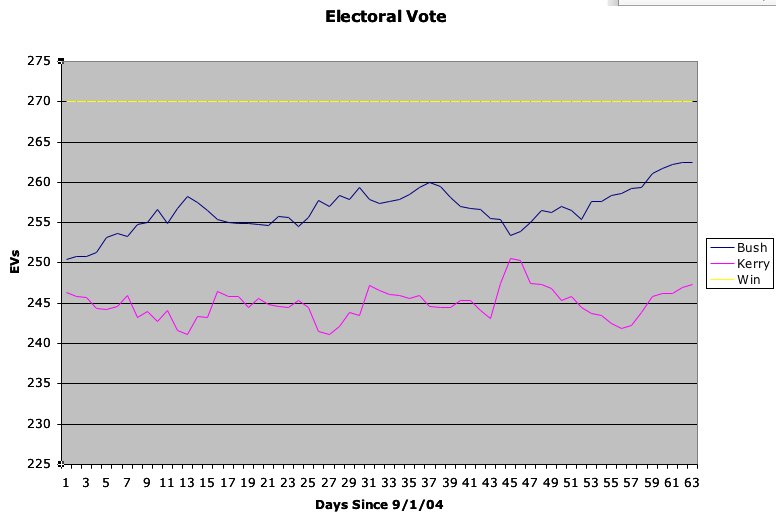
(click for larger version.)
And there you have it. While both are under 270 because of undecided voters, Bush all along had the very clear advantage. Bush needed to win less close states in order to win the election.
And, that's exactly what happened. Kerry outperformed Bush, as Gore did in 2000 (even without Florida). Of the ten closest states this year, Kerry won six, for 69 EVs. Bush won four, for 37 EVs. And, Bush still won.
Bush clearly had more electoral support than Kerry. The only way Kerry could have won was by being extremely, extremely lucky - beyond just not making mistakes.
I wish I had thought of this before the election... if I had gotten it out there enough, it might have shown people how much more work we had to do. At least in the blog activism world, we were really overconfident in the last two weeks, and this could have put a stop to it.
November 05, 2004
2004 Weighted Electoral Result
By the way, if every state had awarded their electoral votes proportionally, so that every vote had counted, the total would have been about:
Bush: 275
Kerry: 258
Nader: 2
Other: 3
Inaccurate Ohio Counts
Some guy at daily kos uncovered an example of inaccurate vote counts in Ohio:
In the Gahanna 1-B precinct, Bush is credited with 4285 votes out of 638 votes cast.
I mentioned to a friend of mine that 5% of me is screaming that surprises in vote counts and absentee/provisional ballots could still affect this race. This doesn't make much difference, but... I guess it's up to 5.5%.
November 04, 2004
Kerry and New Mexico
Evidently, Kerry gets New Mexico. Rumor has it New Mexico local media is reporting that Kerry gets the state. It doesn't really matter, but do with that what you will.Update: Sorry, was misled by a desperate dailykos diary... NM count is still in progress. It's still very close.
Update: Bush wins new Mexico. Bush also wins Iowa.
November 02, 2004
Election Thread
Polls have closed in some states. Check this grid throughout the night for a cool chart on what networks have projected what state. There's also an awesome map at cspan that has the vote totals as they come in.
Bush: GA, IN, KY
Kerry: VT
Good news for Kerry that SC and VA are too close right now.
Mongiardo(D) takes lead in KY Senate race.
Damn, CBS's interactive monitor is really cool.
It's a half hour after close and SC is still not projected for Bush. That's good news, even if Bush ends up winning it.
Too close to call: VA, OH, NC
Too early to call: SC (so it's just a lack of numbers, not necessarily a close race)
More great news for Kerry, although he hasn't won any surprises yet.
CNN has WV for Bush. So do several others. 39-3 Bush. So, not as much opportunity for a Kerry blowout.
NBC mentions that Kerry is still working the media when they hoped he would have been done by now. First twinge of uncertain news on Kerry's side I've heard. Hopefully it's nothing.
Many absentee ballots will not be counted tonight in PA and FL. Hopefully the margin will be enough that it won't matter.
MSNBC says that NC is so close because of the number of voters below age 30, which is preferring Kerry at 60% nationwide.
More polls closing:
Bush: TN AL OK
Kerry: IL NJ MA MD CT ME(3) DC DE
Too close: MO FL OH PA NH
77-66 Kerry. A lot of Bush-favored states are still too close to call, some even an hour after polls have closed. Will one of them break to Kerry?
Bush gets sign of relief for WV, Kerry gets sigh of relief for NJ.
NBC projects Obama to win his senate race. ;-) Networks are downplaying Dem's chances of taking the Senate.
NC is called for Bush. Took long than expected. 81-77 Bush. They also projected SC for Bush. 89-77 Bush? Still no surprises. CBS has projected VA for Bush. 102-77 Bush? Still no surprises.
Too early to call: AR
Oof. Coburn (R) is projected to beat Carson for Senate in OK. That sucks.
Still 102-77 Bush. No surprises so far. And now we're waiting for another half hour until 9PM EST.
Bush: TX KS NE ND SD WY
Kerry: NY RI
Too close: WI, MI, NM, CO, AR, MS, MN, and earlier others.
Still no surprises or switches from 2000. 156-112 Bush
I am starting to feel very suspicious about Republicans in FL and OH.
Bush: LA MS
171-112 Bush, still no surprises.
10 PM EST Closings:
Bush: UT
176-112, no surprises.
Bush: AR
182-112, no surprises.
Bush: MO
193-112, no surprises. I'd like to see more surprises for Kerry, though. Ugh.
Bush: MT
196-112, no surprises still.
Kerry: PA
HUGE sigh of relief for Kerry. 196-133 Bush. Still no surprises, but Kerry really needed PA.
Bush: AZ
206-133 Bush. Still no surprises.
11pm EST calls
Kerry: CA WA
Bush: ID
OR and HI are too early too call.
210-199 Bush. Still no surprises. Come on, Oregon!
Rumors of a large youth turnout were greatly exaggerated. :-(
Knox County in Ohio - nine hour lines.
Some of the more visible leaders over at daily kos are sounding discouraged.
Bush: CO
219-199 Bush. Still no surprises.
Joe Scarborough on MSNBC says that Kerry insiders don't believe they will win the state of Florida. Now, can we believe Joe?
The upper midwest looks good so far for Kerry. If Kerry gets Ohio, I still think he wins.
CNN also reports that Kerry insiders believe they don't have Florida.
Bush: FL
Oof. ABC and CBS call FL for Kerry. I guess it's down to Ohio. 246-199 Bush. This is the first big flip of the night, if you considered Florida rightfully the Democrats'.
Kerry: OR
PHEW!!! But, still no surprises. 246-206 Bush.
I'm going to go out on a limb here and say that Kerry will not get Alaska. Given that, it means that Ohio is now a must-win. If he doesn't get Ohio, Bush gets re-elected.
Kerry: Last EV in Maine.
246-207 Bush. Still not a surprise. If Bush gets Ohio and Alaska and we get everything else, it's 269-269 and Bush is re-elected through the House.
People are getting REALLY pessimistic about Ohio over on daily kos, when they look at the percentage precincts reporting in various democratic counties. They're saying there just aren't enough remaining voters left to make up the margin.
All sorts of Daily Kos members projecting four more years of Bush.
Ugh, Fox projects Ohio for Kerry. They're the only network to project Ohio so far. Deja vu anyone?
Kerry: MN, NH
246-221 Bush. Our first real surprise of the election, Kerry takes New Hampshire from Bush.
MSNBC projects Ohio for Bush.
AL: Bush
If they're right, then we've got 269-207, and Bush is re-elected president - possibly in the House. But rumors are that Bush is ahead in NM.
Fuck.
CNN announces they will not call Ohio because there are over 200,000 provisional ballots out there.
Colorado was called for Bush even though none of Boulder County's (hippieville) ballots will be counted until tomorrow. The margin must be pretty wide.
Right now Nader is deciding Iowa in favor of Bush.
Weird - PBS had projected Bush winning New Hampshire, even though other networks have projected Kerry winning New Hampshire. That's the first clear disagreement in projections.... and, PBS has just corrected its projection, calling NH for Kerry.
Right now it looks like we are in a worse position than we were in 2000. Iowa will not be called tonight because the counters are going home. They are hinting that Bush will win Iowa. Kerry has to win Wisconsin for challenging Ohio to even make sense. And right now it looks like the Democrats are behind by a large amount of voters in the nationwide popular vote.
Turnout overall doesn't look much higher than 2000. None of those 120-million numbers that were bandied about.
Kerry: MI
That makes it 249-238 Bush.
Kerry: HI
That makes it 249-242 Bush.
Evidently Wisconsin is being called for Kerry by local press in Wisconsin. That would make it 252-249 Kerry. That would mean that the only way for Bush to win outright is to win Ohio.
Bush's margin in Ohio is growing.
Reports are that already-reported exit polling results all over the place are being changed to better fit the election results.
I'm done with this thread. TV is being turned off. Summary coming up.
Pre-Election Thread
I will update this posting throughout the night as information comes in.Frank Luntz, GOP Pollster: 'Kerry is going to win' (says Wonkette)
Internet servers are going down all over the place. My poor reload button.
Screw Daylight Savings Time. If not for that, the polls would be starting to close right NOW.
The financial markets where you can bet on Kerry or Bush (Tradesports, IEM) show Bush tanking.
Right now the consensus is that if Kerry keeps his close leads in FL and OH, he wins, and if he doesn't, he loses. I don't really like being in that position, because again, these close leads are how the voters think they voted, but not how the votes have been counted.
Jesus, I just saw a live shot in lines in Georgia. It's horrible. They are actually too long - people will leave. That's horrible.
Even though FL and OH are close, OH had early voting that favored Kerry, so that's good.
The really good news is that Rove's backup strategy - of stealing upper midwest states - looks like it has completely failed. So it's really down to FL and OH for them, too, or stealing something completely unexpected.
I've heard from a few places that it's good news that there haven't been many reported problems with the e-voting machines. It ticks me off - the whole problem is that they can record a vote that you didn't cast, and you wouldn't know.
Ginsberg implies that Democrats are potentially bussing people around to vote at multiple polling locations. Dude, have you seen the lines? There wouldn't be time! He's saying that the problem is Democrats having all these false registrations. If you have a fake registration, who's going to show up? You going to conjure a real Mickey Mouse out of midair?
MSNBC is giving hints about a Kerry victory. Laura Bush reportedly forcing smiles. They refer to Bush campaign officials talking about how exit polling numbers are not going their way, and reassuring people not to trust the numbers...
I'm not sure which network to watch tonight. I'm thinking of watching ABC, even though Dan Rather might be more fun... polls start closing in a half hour.
Republicans are evidently trying to extend the closing time in New Hampshire. Not sure why. As long as you're in line by the time polls close, you can still vote even if it's two hours later. (Hmm... atrios retracted that later...)
Evidently, some states results are already being reported (not sure by whom). IN, KE. Bush is expected to win both handily, but evidently the margin is less than polls led us to believe...? Very few precincts reporting, though.
Hey, more exit polls - 6pm EST exit polls:
Kerry Bush PA 53 Â 46 FL 51 Â 49 NC 48 Â 52 OH 51 Â 49 AK 47 Â 53 MI 51 Â 47 NM 50 Â 49 LA 43 Â 56 CO 48 Â 51 AZ 45 Â 55 MN 54 Â 44 WI 52 Â 47 IA 49 Â 49I've decided this is the pre-election thread. New thread starts at 7pm EST.
Zogby Projects Kerry Win
Zogby waiting until after both rounds of exit polls and has projected Kerry will win the presidency, 311-213.According to this article.
Here's the link. FL, OH, NH. He's also projecting Kerry will lose the popular vote.
The Skinny On Exit Polls
Mystery Pollster: Exit Polls: What You Should KnowA good rundown on exactly how exit polls work. And actuallly, there's no real data to support the belief that either Democrats or Republicans are more or less likely to vote in the morning or afternoon.
The afternoon exit polls are also out at mydd.com - they're about the same as before. Kerry still seems to have the edge.
Remember that in 2000, Gore was ahead in the exit polls. The actual vote total was different. People (morons) took it as proof that exit polling was all screwed up. I still think the other possible explanation is that the votes were changed. Remember that exit polls are the count of who people thought they voted for. They might be wrong.
Polls: Kerry Momentum Muted
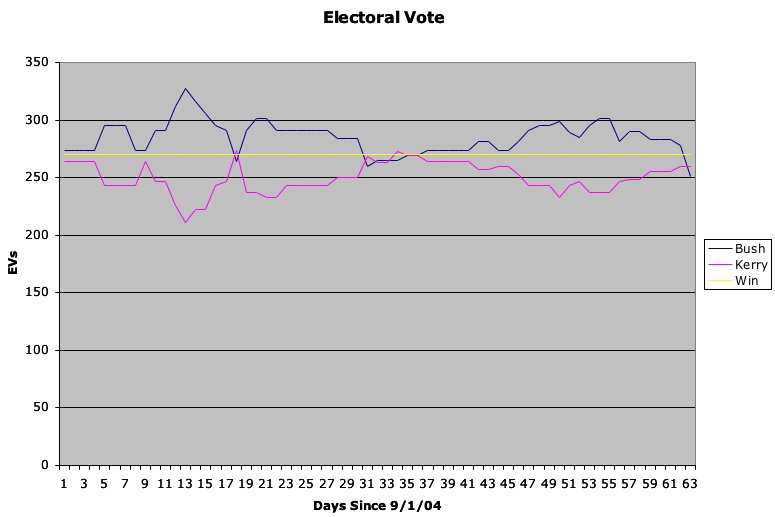
Compare this graph with the one yesterday. What's different is that more polls have been reported that were being asked the same day as the ones that were included yesterday. The additional data shows that Kerry's momentum wasn't as huge as it first seemed. However, Bush's collapse is real.
This graph reflects a tie for Florida. It's a 260-251 lead for Kerry. You'll note it's a different result than what electoral-vote reports for the day, because this one more properly averages polls that are having questions asked on the same day.
2pm Exit Poll Numbers
From MyDD.com:
         AZ  CO  LA  PA  OH  FL  MI  NM  MN  WI  IA  NH
Kerry    45  48  42  60  52  51  51  50  58  52  49  57
Bush     55  51  57  40  48  48  47  48  40  43  49  41
Exit polls don't take early voting and absentee voting into account. They also don't take fraud into account - these are who voters think they voted for.
Also, word is that Republicans tend to vote earlier in the day than Democrats.
So far it looks like the most common prediction - Kerry holds Gore states plus Florida and New Hampshire - is the most realistic one.
Gauging The Victory
After studying Matt Gross's summary, here's the skinny on the election returns. If the EV score is tighter than 75-3 (Bush over Kerry) before 5pm PST, then we have an easy night for Kerry.Otherwise, the pressure points are making sure Kerry gets PA and NJ at 5pm, watching OH at 4, FL at 5, and the Arkansas hail mary at 5:30.
If there's no clear good surprises for Kerry by then, then we have a tight night. Eek.
The most common prediction for the Democrat pundits is that Kerry duplicates the Gore states, while also getting FL and NH.
I think that's boring. I want blowout.
November 01, 2004
Kerry Has Momentum - Proof
(click for larger image)
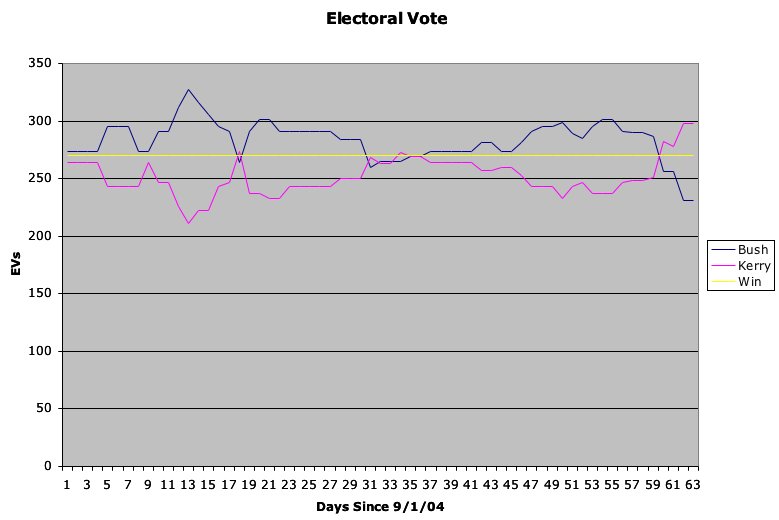
This is a graph of all the polls over at Electoral-Vote.com. But unlike how that site communicates the polls, this organizes the numbers in a much more stable way - by matching up the poll numbers with the date that the questions were being asked.
This means that the numbers are always a few days old, because of the time it takes to release a poll. If a poll taken on 10/24 is reported on 10/29, its numbers here are assigned to the 10/24 date.
But here you can see that given the numbers already reported, Kerry has overtaken Bush. This doesn't even take into account the very recent momentum, because those polls are still happening.
This includes all reported polls, all of which use RV numbers.
October 29, 2004
10/29 EV Status
How's it looking so far? It's really hard to say. If you go by today's polls, then it looks like Bush is winning. There are two states that I strongly disagree with in this scenario, though. First Hawaii is going to Kerry. Everyone's reacting to these two polls that show Bush threatening, but they're completely misleading. Kerry's got Hawaii in the bag. The other state is MN. That state has same-day voter registration. There's no question that that benefits Democrats, who always want more turnout. So what does that mean?It means that not counting Michigan, you have each candidate at 250 EVs. Michigan is 17 EVs, which means it would only take each candidate to 267 EVs, which isn't enough. It means Michigan doesn't matter. So in this scenario, it means that whoever wins PA wins the election.
Now, that's assuming polls are accurate (aside from a couple of obvious adjustments).
But there are plenty of other pro-Democratic arguments to make. And here's where I am unsure. I'm in a bubble, I admit it. So I don't know if this is just whistling past a graveyard. We Democrats were stunned about the 2002 midterm elections. We thought we would be making gains in Congress, and instead we lost ground. I'm not sure we learned our lesson from that. But, here are the bubble reasons.
- Undecideds: There are still a few undecideds - around three or four percent. It's less than in 2000, when we had 7% undecided at this point. Undecideds right now believe 2:1 that it's time for a new direction. Most people believe undecideds will break against the incumbent by a wide margin.
- Registrations: Democrats have evidently won the registration wars, and recent registrations aren't usually included in polling.
- Turnout: The argument is that Democrats will win turnout.
- Otherwise inaccurate polls: Even aside from registration and turnout, the argument is that the polls themselves are inaccurate by counting too many Republicans in their samples.
But it's hard. That's an awful lot of faith to have. The GOP surprised us in 2002 using their 72-hour strategy for the first time, and they'll be using it again.
On the other hand, I don't think anyone is anymore making a serious argument for a Bush blowout.
October 27, 2004
Voter Disenfranchisement
There's been some news and comments about voter disenfranchisement on both sides of the aisle. The Republicans trying to disenfranchise minorities and old women either by intimidating or confusing them, or using the rules to depress their vote (guaranteeing long lines at the polls, etc). And, Democrats trying to discourage the evangelical part of the Republican base, and keeping Nader off the ballot.First, I'm not an expert on ballot rules from state to state, but I don't think there's anything that keeps anyone from voting for Nader as a write-in candidate, and having that vote counted. Is there? I'm actually a bit confused on this point because Nader's ballot drive mentions things like "certifying him as a write-in candidate". Isn't anyone certified as a write-in candidate by default?
If having Nader off the ballot means that a vote for Nader won't even be counted, then I'm inclined to think that's unfair to the people voting for Nader. But, right now I really don't think that happens - please correct me if I'm wrong.
Aside from that, having a candidate on the ballot is just a marketing benefit. There's limited physical space on the ballot, and a candidate has to exhibit a certain level of support in order to get the visibility. There's not really a catch-22 there, because if a candidate is reliant on the ballot placement in order to get exposure, then there's obviously no chance of them winning.
I do think it's a shame that ballot access rules are so different from state to state. You'd expect different numerical requirements, but the percentages should probably be more in line.
That said, in many of these states, Nader hasn't been even close to meeting the requirements. And whining about disenfranchisement in those cases is disingenuous. When you compare Nader's fraudulent signatures to the Dem's legal efforts to challenge those signatures, I think it's clear who it is that is trying to game the system.
And really, it's beside the point. The Democrats are not trying to disenfranchise any Nader voters. They gain nothing by keeping them from going to the polls. They gain a lot by convincing them to vote for Kerry instead, but they'd actually rather Nader voters go to the polls, because if they were to switch their votes to one of the other two candidates, they'd be more likely to choose Kerry.
So it isn't comparable to Republican efforts to keep people from voting.
Some things that Democrats point out do sometimes have an effect of keeping religious fundamentalist evangelicals from voting enthusiastically. But this is because the Republicans are hypocritical when you compare their actions and convictions. Pointing out that Bush has been arrested multiple times, or has a drug past, or a drunken driving past, can be relevant. If it honestly didn't matter to the conservative voters, then their vote patterns wouldn't change. But the fact that it depresses their turnout proves that Bush's history matters to them, and that they were first under the impression that Bush was more moral than he claimed to be. Finally, these exposures are truthful - just because it has a pro-Kerry benefit doesn't mean that they're not relevant.
And again, Democrats are doing nothing to actually keep these people from the polls - they're not putting polling places in strip bars or pagan temples. They're not shutting down polling places in rich areas, or passing laws to not accept ballots from precincts that were within 1000 yards of a church. They're not setting up highway checkpoints staffed by atheists and devil-worshippers to intimidate the good Christian folks.
The Republicans are, however, making large lists of minority voters to personally challenge them at polling places. They are still sponsoring lists that falsely note minorities as being felons. They are still trying to keep ex-felons from voting when they are allowed to vote. They are setting up highway checkpoints staffed by white cops to intimidate black voters. They are limiting the number of polling places in minority-rich neighborhoods. They are making phone calls to tell people that their voting precinct has been changed. They are forcing challenged voters to fill out provisional ballots instead of real ballots. They've passed laws saying that voters who cast provisional ballots at the wrong precincts (many of whom will show up at the wrong precincts at the instruction of pro-GOP groups) will have their ballots thrown away. There are tens of thousands of missing and late absentee ballots in states run by Republican secretaries of states.
I don't know how to make it clearer. There is no even-handed comparison between what the Democrats have done, and what the Republicans are doing. None.
October 23, 2004
Accidental Bush Votes
The Travis County Democratic Party has a memo about some voting errors.Basically what happened is that voters were picking "straight democrat", and then finding that the ballot had them marked down as a Bush/Cheney vote (which they were then able to correct before submitting the ballot).
When pressing ENTER after marking Straight Democrat, some voters inadvertently turned the SELECT wheel one click through the ballot while meaning to go to the final "PROOF" page. If you hit ENTER at that point, your cursor is over the first candidate on the ballot: Bush/Cheney.Interesting, eh? That's either bad UI design by a nonpartisan, or... really good UI design by a Republican...
October 15, 2004
Vote Registration
Well, I think the registration deadline in Oregon has passed (right?), and I still haven't gotten my voter registration card. Anyone know who I check with? I'm in Multnomah County. I registered at the DMV and dropped the card in the slot.Update: Thanks to the editor at communique. I checked and I'm registered. Whew!
October 09, 2004
Voting Rule Battles
Here's another article where the writers twist themselves into a pretzel in order to be evenhanded.
In the battlegrounds of Ohio and Missouri, Republican secretaries of state have crafted election rules that Democrats say could disenfranchise legitimate voters likely to cast ballots for Kerry. Republicans say Democratic election officials in New Mexico and Iowa are making it easier for potential Kerry supporters to vote.
Come on! In both cases, Democrats are trying to enable MORE voters, and Republicans are trying to RESTRICT voters from participating.
In fact, if you read the whole article, you see example after example, with Republicans always trying to throw OUT voters, and Democrats trying to include them.
Who's on the wrong side here? Come on, can there be any clearer proof that Republicans are anti-democracy? They know that the more fair an election is, the less power they have. That's an indictment right there. There's no reason to be even-handed here. The Republicans are pro-fraud, the Democrats are anti-fraud, and there's no way around that.
August 01, 2004
Colorado's Electoral Votes
It appears that my home state of Colorado is considering a twist on the Electoral College that could make the election even more exciting.Colorado has 9 EV's. States are normally winner-take-all, and a candidate needs 270 EV's to win. Colorado has been pretty solidly for Bush lately, so they've been counting on those EV's.
Each state, however, is allowed to determine how to award those EV's. It doesn't have to be winner-take-all. What Colorado is considering doing is awarding them proportionally. So if Bush gets 55% of the vote and Kerry gets 45% of the vote, Bush would get 5 EVs and Kerry would get 4 EVs.
This could have a huge effect on the election given how close the two candidates have been. Bush only won 2000 by three EVs.
But what makes it even more exciting is that if it makes it on the ballot, which seems likely, we won't know if Colorado's EVs will be awarded proportionally until election night itself! The ballot will be voted on that night, and if it passes, the EVs will be awarded proportionally, and if it doesn't, it will be winner-take-all. This means that even if Colorado is firmly for one candidate or another, Colorado's EV picture could still be tight if the ballot measure results themselves are tight.
Now, is this generally a good idea? I think it is. It enfranchises more voters and gives them more of a voice within a state. Now, if California, a solid Democratic state, were considering it, I'd be a lot more worried, because California is a solidly Democratic state. So I can see how Republicans would be alarmed by this!
What would be a better approach is to have all states switch to this proportional method at once. Perhaps states could pass measures that would say that they would switch to the new method, but only as soon as a set number of other states do as well.
What would be even better is if they allowed fractional EVs. Otherwise, battleground states with an even number of EVs would be quite boring, while battleground states with an odd number of EVs would get all the action.
All in all though, this will have a large effect on future elections. If Colorado becomes proportional, and in future elections it is shown that the vote is pretty close, candidates aren't going to want to spend millions of dollars to fight over one puny EV - when otherwise they'd be fighting over nine.
Monitoring Polling Places
Monitor Polling PlacesThere are a lot of counties that are going to be using voting systems where there is significant opportunity for fraud that can't be proven afterward.
I started idly thinking about launching a website to publicly track communications with various counties and allow people to post status updates. It turns out some other folks are thinking along the same lines. This is one such site.
April 22, 2004
Diebold Admits Fraud
It seems straight out of the twilight zone, but Diebold admitted they defrauded California and then lied about it."Why did we sell something that we didn't think we could run? Our understanding based on past experience was we thought we could get that certified."I don't know what their strategy is, do they have some sort of Jedi mind power to convince CA to give them one more chance? That's what they're asking for. I'm afraid it might actually work. What California needs to do is scold them aggressively and publicly and then sue them - maybe that would get momentum going in other states in time for the fall.
April 05, 2004
Nader Is Not A Spoiler?
One of my subproofs for NaderShouldNotRun is possibly contested:
Testing Ralph Nader to see if he fits the definition of a ThirdPartySpoiler:
- Nader is running for President. This is a fact.
- Nader is running against Kerry and Bush, both of who have a clear shot at winning
- Nader is clearly closer to Kerry in ideological support, as evidenced by how the poll numbers break down when Nader is removed from the equation
- Our election system does not allow voters to record choice preferences. Only first choice counts.
Possibly contested:
By the election, all of Nader's supporters will have had to have heard the logic that voting for Nader makes Bush's re-election more possible. In this sense, if they are voting for Nader anyway, knowing that Nader cannot win, then they are basically saying that if Nader is in the race, they prefer Bush to Kerry, even if otherwise they would prefer Kerry to Bush. So, this might be reason to believe that Nader's objective support is not ideologically closer to Kerry. In other words, if the result throws the election to Bush, due to the voting action of several people that know the effects of their action, then DemocraticIntent might actually be served.
Discussion on Daily Kos.
Open Letter to Nader Supporter
I posted this as a comment on another weblog and it got some good response. It's similar to what I've written before, but I think I pulled it together pretty well.Remember that politics is about reconciling passion with what is possible.If you vote for Nader, the objectives you care about become less possible, not more. There just isn't a way around that. If you vote for Nader, you're basically saying that your personal passions are more important than enacting change.
This whole thing is about a misunderstanding on what it means to have integrity. You're told that if you don't vote your "true conviction", then you're settling, compromising, et cetera, and that committed citizens don't do that.
That's not integrity. You're being manipulated. The truth is that you are being put in a double-bind, where you're damned either way. Either you go against your convictions, or you make it more likely that Bush will be elected. The situations SUCKS and we can all agree on that.
But the way to oppose a double-bind is not to choose one side and then close your mind and claim victory. You actually have to take the double-bind apart.
The double-bind is the electoral college, which is structured in such a way so that it only works well when it's only between two candidates. Work to change it if that ticks you off. Your efforts are better served working to change the voting system so the spoiler effect doesn't happen.
And the double-bind is also Ralph Nader, because it was his choice to put you all in this position. I say his choice, because he actually did have a costless alternative.
Think about it - if his goals were merely to represent your views and to build support (and remember, he's just an independent now, not even trying to build a third party) - he could have run in the Democratic Primary. There's nothing that says in order to run in the Primary, you have to compromise your platform in any particular way. But he chose against it for selfish reasons.
In short. Ralph's goals are not yours. Ralph's actions are not aligned with his stated intent. He knows he won't win. Remember that to win he needs to win several states outright, at least the 11 largest. Even if he gets 20% support nationwide, the E.C. means he won't win a single state. He knows he can't beat the E.C. and there is no other way for him to win. He knows that if he can't win, his presence makes it more likely that Bush will be elected. He knows that Bush being elected will mean the government has less audience for his passions than Kerry would. And he is running anyway. And so Nader is similarly putting himself in a double-bind, forcing himself to choose between his passion, and results.
It is a false choice. Nader's made his choice and he probably isn't saveable. But the tragedy here is that he's conning his supporters, people like you who might still actually care about affecting change.
Politics is about reconciling passion with what is possible. You can't forget that, because when you do, you actually *undermine* what you are passionate about. It is your *choice* to participate in a voting system, but when you do, it's your responsibility to know what the possibilities of that system are. You have to submit to the system if you choose to work within it. It is your *choice* to support Nader, but it's your responsibility to realize that voting for him reduces the likelihood of your passions being represented. And it's your responsibility to make sure that your actions are aligned with your intent. There are better ways to advocate your beliefs than to cast a pointless and *counterproductve* vote for Nader.
March 29, 2004
Social Proof: Nader Should Not Run
I have updated my latest Social Proof, NaderShouldNotRun:
NaderCannotWinDemocratically proves that Nader cannot win without undermining DemocraticIntent; i.e. cannot win democratically.
ProtectingDemocraticIntent proves that a ThirdPartySpoiler that cannot win democratically undermines DemocraticIntent.
Nader is a ThirdPartySpoiler, by definition.
DemocraticIntentMustBeProtected proves that DemocraticIntent must not be undermined.
Therefore, since Nader's run undermines DemocraticIntent, Nader should not run for President.
Parent: ProofList
Here are the subproofs:
NaderCannotWinThePresidency is socially proven, contested by NuclearNader.
NuclearNaderIsNotDemocratic proves that winning through the NuclearNader scenario is not a democratic win.
Therefore, Nader cannot win democratically.
Parent: NaderShouldNotRun
NaderCannotWinThePresidency was covered in a previous entry, but here are the Proofs concerning NuclearNader:
There is one scenario that says Nader could win one state, limiting the others from winning 270 Electoral Votes, and then demand that Kerry assign all his delegates to him by proclaiming that he doesn't care if Bush wins over Kerry (since Bush would probably beat Kerry in the House Of Reps). This is arguably absurd, but we haven't yet proven it impossible. Are delegates from any states prohibited from casting Electoral Votes for someone other than the winner, even if the winner wishes it? A proof would probably have to look closely at precedent and social pressures on delegates to guarantee this wouldn't happen.
Parent: NaderNeedsToWinLotsOfStates
NuclearNader describes a scenario where Kerry's delegates plus Nader's delegates would be enough to beat Bush.
Since Nader would only win one state, this would mean that the population as a whole would prefer Kerry to Nader. The population as a whole would also prefer Bush to Nader.
Therefore, the DemocraticIntent of the voting population is clearly not Nader.
Nader winning in this fashion would therefore be undemocratic.
Parent: NaderShouldNotRun
And for the remainder of the proof:
The "Third Party Spoiler" is a type of candidate (referred to herein as a "spoiler") that can make one winnable candidate lose to another, when it might otherwise beat the other. Not all candidates are spoilers. Not all third party candidates are spoilers. A spoiler will not definitely affect an election in this way; it's only a possible outcome.
We define a spoiler as a candidate that fits all the below required criteria.
- The spoiler is running
- The spoiler is running against other candidates who do have a clear shot at winning ("winnable candidates")
- The spoiler is clearly ideologically closer to one of the winnable candidates than the other(s), in terms of voter support
- The spoiler is participating in an election that does not allow the spoiler's supporters to register preference between the other winnable candidates.
Reasoning:
A spoiler gets support from a variety of supporters. We define a "preferenced supporter" as a supporter of the spoiler, that also has a preference among the winnable candidiates. This means that if the spoiler wasn't running, the spoiler's supporters would vote for that other winnable candidate.
Since the spoiler is ideologically closer to one party, some of the spoiler's support would come from preferenced supporters of that party's candidate. The spoiler would also have more preferenced supporters from that candidate than from another.
If so, then if the spoiler loses, a winnable candidate could then lose to another winnable candidate, even if the population as a whole preferred the losing winnable candidate to the winner.
Parent: NaderShouldNotRun
The Democratic Intent of the voters can be defined as the candidate that the population prefers overall, among a group of candidates. In a group of two candidates, the majority preference is the Democratic Intent.
There is an absolute definition of DemocraticIntent.
In matters where a population has a direct input, it is a truism that DemocraticIntent must be protected in order for it to be a Democracy. Since states decide presidential elections, DemocraticIntent must be protected on a state level.
A ThirdPartySpoiler is capable of spoiling an election, but may not. In cases where a ThirdPartySpoiler has a shot at winning, then by definition that means they may be the DemocraticIntent of the population.
If a candidate may be the DemocraticIntent, then excluding them from the race would also undermine DemocraticIntent.
Therefore, any ThirdPartySpoiler that has a chance at winning democratically should run. While they may turn out to spoil the election, this would only be clear after the fact.
However, a candidate that does not have a chance of winning democratically only has two possible outcomes. They have a chance of having no effect, and they have a chance of undermining DemocraticIntent. But, their presence does nothing to protect DemocraticIntent. No matter what, their presence reduces the likelihood of DemocraticIntent being expressed. The presence of such a candidate may have value in terms of "providing a voice" to voters in the minority, but at the cost of making it less likely that DemocraticIntent will be expressed.
Therefore, a ThirdPartySpoiler that has no chance at winning democratically undermines DemocraticIntent.
Parent: NaderShouldNotRun
DemocraticIntent must be protected. This is pretty much a truism. Anyone opposing this argument for politic purposes would be exposing Democracy to the same sort of abuse from their political enemies.
American Democracy is about majority rule, without minorities being trampled. This is not the same as minority rule. Minorities are given protection, but not the right to win elections outright.
DemocraticIntent must be protected. If it is currently undermined, we must work toward restoring it.
Parent: NaderShouldNotRun
Seeking input to make it stronger. The idea is to point out that any argument supporting a Nader presidential run is either undemocratic, or under the impression that Nader will win several states outright in November.
March 09, 2004
Third Party Presidential Spoilers
I'm trying to abstract out a definition of Third Party Presidential Spoilers. Let me know if you can think of any holes or exceptions in this, or if you disagree with it, on what grounds.
The "Third Party Presidential Spoiler" is a type of candidate (referred to as a "spoiler") that can make one winnable candidate lose to another, when they might otherwise beat the other. Not all presidential candidates are spoilers. Not all third party presidential candidates are spoilers. There nonetheless exists a type of candidate that is a spoiler, and this is the definition and proof.
We can define a spoiler as a candidate that fits all the below criteria.
- The spoiler is running for president
- The spoiler does not have a shot at winning the election
- The spoiler is running against other candidates who do have a clear shot at winning ("winnable candidates")
- The spoiler is clearly ideologically closer to one of the winnable candidates than the other(s), in terms of voter support
- The spoiler is participating in an election that does not allow the spoiler's supporters to register preference between the winnable candidates.
Reasoning:
A spoiler gets support from a variety of supporters. We define a "preferenced supporter" as a supporter of the spoiler, that also has a preference among the winnable candidiates.
Since the spoiler is ideologically closer to one party, some of the spoiler's support would come from preferenced supporters of that party's candidate. The spoiler would also have more preferenced supporters from that candidate than from another.
If so, then an otherwise winnable candidate could then lose to another winnable candidate, even though the population as a whole preferred that losing winnable candidate.
(You can even edit it over on my wiki; follow the link at the top of the block.)
March 08, 2004
Kerry's 2004 Electoral Map
Update: Read my weblog for up-to-date commentary on the election.According to a report linked to by political wire, here is how the electoral map currently looks for Kerry and Bush in 2004 (click for larger version).
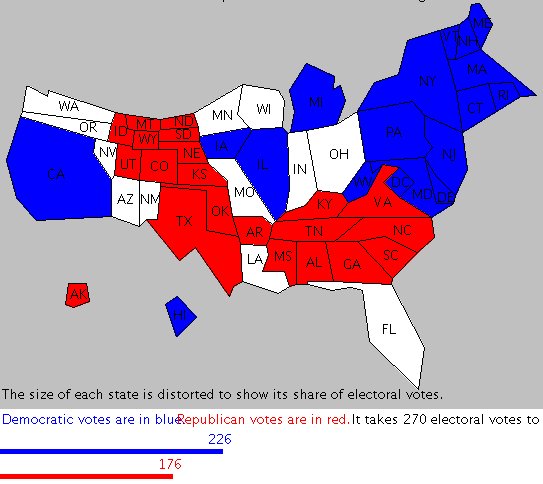
Red is Bush, blue is Kerry, white is "in play". And right now, Kerry is leading in Florida...
(Made using this cool electoral map tool.)
Update: Please note this map is many days out of date. Here is the up-to-date synopsis of the electoral vote (updated daily):

It links to electoral-vote.com, which is updated every day from the latest polls.
This entry is part of my weblog, which you can read for daily updates on politics, media, and rhetoric. Other recent entries you may be interested in:
February 25, 2004
Third Party Realities
This is an article that was submitted to kuro5hin.org and then rejected due to partisan voting.Over the last couple of years, I have done quite a bit of research into U.S. political voting systems and various vote-counting methods. I've come up with the following conclusions, some of which I didn't expect:
- The presidential race should absolutely not have third-party candidates.
- Preference voting is not the answer for presidential voting while the Electoral College exists.
- Democrats and Greens need to share fault for 2000, and share the responsibility to join forces in 2004.
- Bush technically had more electoral support than Gore even without the Supreme Court's help.
Submitting to Systems; Pragmatic Principles
One of the basic principles that guided my research was the conviction that when one submits to a system, one also has to submit to the pragmatism that that system requires. I can argue all I want about the inequities of our current voting system, but if I'm going to use it (as I should since the political effects will ultimately affect me), I should use it in a way that aligns with my political intent.
For instance, Nader asked us to "vote our principles" in 2000, when many of us had principles that said we liked Nader best, but preferred Gore to Bush. The problem was that our voting system did not have room for these principles. By asking us to ignore our preference of Gore over Bush, those who had that preference but voted for Nader were ultimately casting an unprincipled vote. (Those that believed Nader actually had a shot at winning, or who honestly saw no difference between Bush and Gore, however, were casting principled, if uneducated, votes.) I came to the conclusion that what would have been more principled would be to vote for the candidate closest to my beliefs that had a shot at winning, and then work to implement a voting system that had more room for my principles.
The Electoral College
One system we are forced to submit to is the Electoral College. The first thing to realize about the Electoral College is that it will be very, very, very hard to change it. If 2000 didn't change it, it is hard to imagine what it would require given our current congressional makeup. Replacing it with a nationwide popular vote won't happen as it is too counter to the interests of Congress; it would likely require a different scheme to advocate. At this point, it looks like it would require massive congressional change over a period of years to get enough representatives in there that would vote to overturn it.
Until that happens, it is the only game in town for electing Presidents. And there's one important facet of it to keep in mind: it requires a majority of 270 votes (out of 538) to win.
What this basically means is that for someone to win the Electoral College outright, they have to get more electoral support than all other Presidential Candidates combined. It's not enough to make a good show. You have to decimate the field. Right now when we have two major parties, it's not a big deal, because no other party strongly competes with them.
But imagine what would happen should a Green, Libertarian, or Reform candidate get enough support to actually win a state or two. First, absolutely nothing happens for the third-party candidate. They would have to win at least the eleven most populous states (which includes California, Florida, and Texas; a strange trifecta). But, what would happen is that either the third party would be ideologically similar to one of the two major parties, splitting its support, or it would lead to none of the parties getting 270 votes.
When no candidate gets 270 votes, the election goes to Congress for them to decide among themselves. And unless the third party has strong congressional representation, they are out of luck.
The long and short of it is that if a third party wants to become president, they are either going to have to have a strong enough national party to enable them to win several states outright, or they are going to have to have a strong enough national party that they would have a plurality of congressional representatives in Congress. Either way, it requires a strong national party with significant local and statewide support and a significant number of elected officials. None of our third parties have this level of strong support at this time.
Now, the lazy conclusion would be to think that the third parties should shut up and go away. This is of course wrong. Instead, they should seek to form coalitions.
When more than two parties are represented in parliament or Congress, and when a bill requires a Yes or a No vote, the multiple parties coalesce into two camps. What's important to realize is that coalitions always ensue in democracy. The difference is when they happen.
In parliamentary democracies, the coalitions happen after the representatives are elected. In an effective American democracy, the coalitions can still happen; they just need to happen before the election. This is the advantage the GOP has over the Democrats right now - they have learned this lesson, while the Democrats have not. In 2000, the Greens and the Democrats failed to form a coalition, which is the fault of both parties.
Due to all of this, the reality is that until a third party has a strong enough national party to compete in a presidential election or in Congress, the only way to pragmatically play the game in presidential races is to form coalitions with the party that they are closest to in ideology.
Preference Voting
One way to make it easier for third parties to build nationwide support is to allow preference voting. Preference voting allows people to specify their full preferences and protect themselves from vote-splitting and "lesser of two evils" voting. However, preference voting is not a good idea for presidential elections.
For as long as the electoral college exists, presidential elections will be decided on the state level, state by state. Given the requirements of the electoral college, preference voting only makes it easier for a third party to win a state here and there, throwing the election to the House. This should not be toyed with until a third party honestly has a realistic chance of winning 270 votes worth of states all in one year. For those seeking to implement preference voting, the responsible approach is to seek to implement them for local and statewide races (including national congressional races) in order to build strong national support. But in the meantime, for presidential elections, forming coalitions is the best approach.
And a word about preference voting: it is well-established by now in voting theory circles that IRV is flawed and Condorcet - where the winner beats every other candidate in a head-to-head matchup - is superior. There is also fondness for Approval voting, but there is one problem with this - many state constitutions already make allowances for ranked voting, but not for Approval voting. There is more of an obstacle against it. Approval voting also has a psychological barrier in that people tend to think in choices, and user testing has shown that voters tend to resent giving an equally-weighted vote to their second choice, especially when it results in their second choice winning the election. This has resulted in Approval voting being approved and then thrown out in at least one locality that I've heard of, although I can't find the reference.
National Electoral Support
One of the irrelevant statistics in judging presidential races is the national poll. This is because our presidency is not decided by a national popular vote. Instead, our less populous states are given extra weighting compared to our more populous states, to recognize state sovereignty. This is consistent with how Congress is set up - more populous states get more Representatives, but every state gets two Senators. For presidential voting, every state gets an electoral vote for each Rep and Senator.
A good way to calculate actual nationwide support is to weigh the nationwide popular vote by each state's electoral power. While the implementation of our electoral college is antiquated, this is a way to calculate its actual intent. I calculated this for the 2000 results. I took each state's electoral votes, and split them up proportionally to each presidential candidate, according to how many votes that candidate got in that state. Using this formula, we find for instance that Gore got 12.16 electoral votes in Texas out of 32.
After totalling up all the voting power for each of the candidates, I calculated the "electorally-weighted popular vote", and came to an interesting result. Bush actually outscored Gore. There was no winner take all factor - a swing of a few hundred votes in Florida made no difference. But by applying the ratios to the popular vote, I had a weighted popular vote, with Bush getting 48.17% of the vote, and Gore getting 48.03% of the vote. Bush actually had more electoral support nationwide than Gore did.
Accepting for the moment that Gore actually won Florida, then why did Gore win? There are many inequities in the electoral college implementation, chiefly among them being the winner-take-all nature of each state. And I found that of the seven closest states, Gore got five of them. The other two were New Hampshire, and Florida. The inequities actually worked in Gore's favor, overall.
Now, it is important to remember that these are counting the votes as they were recorded by the various Secretaries of State. And given what we know about Florida disenfranchising tens of thousands of ex-felons (and non-felons), we know that the intent of the voters were more for Gore than the recorded tally shows. I personally believe that the GOP has a fraud advantage of 0.5 - 1%. However, there is not good reason to believe that the fraud advantage the GOP had in 2000 has lessened since then, especially with the onset of blackbox voting.
The basic thing to realize here is that if Democrats want to win in 2004, it is not enough to wish to duplicate 2000 simply with a fairer count. First, there isn't a good reason to expect a much fairer count, and second, the Democrats actually had less electoral support in 2000, only "winning" due to electoral college inequities working in their favor, which is hard to control in future elections. To win, Democrats really do need to build more support.
Conclusion
Overall, this suggests a clear strategy for those interested in supporting Democrats and Greens, improving democracy, opposing the current administration, and having our votes better represent our intent:
- Recognize that 2004 is about building new support for Democrats and constructing arguments to appeal to ambivalent and swing voters.
- To support third parties, immediately seek to always run a candidate against an otherwise unopposed incumbent congressional member. Several House races every year run unopposed, and there would be no vote-splitting cost to run a third party candidate against them.
- Research state constitutions and secretary-of-state policies about preference voting, and lobby your state legislature to allow preference voting for state issues. Start on the local level to familiarize voters. Advocate vote-counting systems where the winner is always from the Schwartz set of Condorcet voting, because vote theorists agree that this is always the most fair result if the intent is to represent consensus public support. Advocate preference voting for local, state, and national congressional elections.
- For presidential races, convince your third party to become active in lobbying the major party that is closest to its ideology, to extract concessions for your party's support.
- Oppose third party presidential races for as long as the Electoral College exists, until a third party has significant nationwide support.
- Oppose opportunity for vote fraud by supporting congressional bills that require paper trails (which are NOT the same thing as receipts that voters take with them, and are therefore not open to the vote-trading flaw), such as Congressman Holt's H.R. 2239 and its companion Senate bill.
There are of course other theoretical and idealistic ways to advocate better U.S. democracy, but at this point they all require either a belief that everything will suddenly change, or a long view of it taking decades to implement. If you subscribe to the long view, work for what you believe in, but consider supporting these shorter-term pragmatic efforts as well.
February 21, 2004
Nader Joins The Argument
The Nation has an open letter to Ralph Nader pleading with him not to run for president.Ralph Nader has written a response.
I like what Ralph writes. He spells out a lot of problems, and a lot of reasons to take action against those problems.
However, nowhere does he show that that action must be Ralph Nader running for president.
Nader is a liberal. I mean, come on. He reads The Nation. Rail all you want at how we are prisoners of a linear metaphor, but he's going to get more support from those who prefer Dem over Bush than those who prefer Bush over Dem.
At the end of the day, he says he's trying to defend liberal interests, but he's doing it by holding them hostage.
"Love animals more, or else the kitten gets it!"
The thing that really bugs me about this is that I'm the type inclined to support Nader. I donated to the Green party in 2000. I like his platform better than I like the Democratic voting record. But I've also put a lot of thought - available in these archives - into what American voting means, where it's messed up, and - most importantly - the best steps to take to improve it. Nader's implication is that the only reason I'm not supporting him is because of fear, or because I'm a sheep, or because I somehow lack the consciousness he has. It's insulting; to me, and to other people whose support he needs.
February 20, 2004
WA Strangeness Continued
I'm getting closer to having a wrap-up of the whole WA caucus matter. In short it looks like there won't be answers to some of the relevant questions. I've been in contact with people from the WA Democratic Party, and they've been somewhat helpful. I hope to have the details up in a couple of days.
February 17, 2004
WI Projected For Kerry
From the CNN partial returns for Wisconsin...
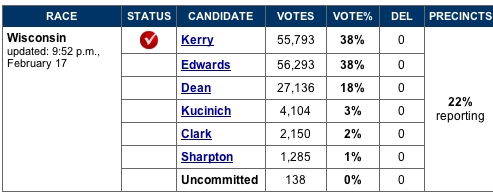
As I said, I think the whole vote-counting thing with projections is weird. See here as Kerry is projected winner even as Edwards currently has more votes.
Update: Obviously, projections is a technical business having to do with statistical sampling and analyzing which sets of returns have already come in and which ones haven't. I just thought it was amusing to see the numbers in that shape.
February 15, 2004
Electoral College Notes
I've written before that I like the basic intent of the Electoral College and how it tries to represent region as well as population.It's the implementation that I don't like - each state being winner-take-all, with the national winner requiring a majority rather than a plurality. It's what makes third-party presidential runs such a threat to our democracy.
I've thought a better version would be to proportionally award EVs for each state by the percentage support each candidate gets, and allow fractional EVs, and allow a plurality of the total to determine the nominee. It doesn't get rid of the spoiler problem, but it does then mean that we can use preference voting, like Condorcet, to find the winner of each state.
However, I just thought of a problem with that. There is no solid way to determine proportional support for each candidate, that I know of, using preference voting like IRV or Condorcet. You can determine 1st place, 2nd place, etc, but you can't determine what percentage of support each candidate got.
So hrm. I'm stuck again.
February 13, 2004
Recount Solution: Don't Recount!
This article describes Florida's novel solution to the whole ballot recount problem - just don't require recounts anymore.
February 09, 2004
Calling the WA Democratic Party
I have another status report over at dailykos regarding my efforts to talk to people in WA about all the numbers. See my previous entry to know what I'm talking about.
February 07, 2004
Precinct Reporting Is Weird
Here were the precinct results in WA with 16 precincts reporting:
       John Kerry      Dem     593     35.0%     0
       Howard Dean     Dem     486     28.7%     0
       Dennis Kucinich Dem     432     25.5%     0
       Wesley Clark    Dem     66       3.9%     0
       John Edwards    Dem     58       3.4%     0
(update: This probably was supposed to be 16% precincts reporting.)
And here they were with 140 precincts reporting:
       John Kerry      Dem    1321     49.3%     0
       Dennis Kucinich Dem     499     18.6%     0
       Howard Dean     Dem     487     18.2%     0
       Wesley Clark    Dem     151      5.6%     0
       John Edwards    Dem     138      5.2%     0
(update: I corrected a typo in the above table. Plus, 140 precincts has to be wrong, because there are an average of four delegates per precinct in WA. This had to have been a typo on the AP's part. It's more like 1300-1350 precincts.)
That strikes me as odd. What's with Kerry practically sweeping 124 4% of the precincts, except for Kucinich having significant support and Dean coming in last with only one additional delegate?
Here's a history of the WA precinct reporting.
Update: I also wrote about this over at daily kos where it is starting to raise some concern. I'm relieved because I thought it would just look like I was trying to make an issue out of nothing. I just want to nail down the loose ends. Others are sharing stories about how when a precinct came up with votes, the computer operator input a different number of votes. Please read on or participate if you have ideas for next steps, if any.
Update: There is a follow-up post at dailykos detailing one voter's experience of witnessing delegates being unfairly taken away from Howard Dean.
Update: There is another another follow-up over at dailykos that shows status from the above WA voter in trying to verify precinct data.
Update: Make sure to read my main weblog to see more status reports.
Read on for more details...
This is the screenshot of when 140 ~20% of the precincts were reporting. Dean gains one delegate out of 124 4% of the precincts, while Kucinich gains 67.
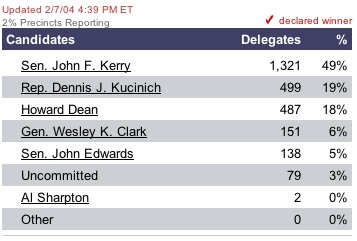
Then for a short while, CNN had the following numbers up - with 21% (around 1376) precincts reporting. Kerry's numbers are slightly less, and Kucinich's are signifcantly less, enough for there to appear to be a much bigger lead for Kerry. The Kucinich situation is strange because he had a strong total for a more than one phase of reporting, and here his numbers go down significantly. If this was a simple error, what was it? These numbers, used by CNN and Fox, were not AP numbers, and Fox was overheard saying they got their numbers from the Democratic National Headquarters.
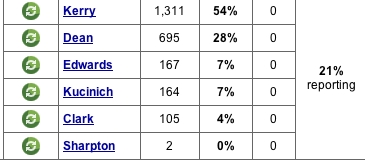
Almost simultaneously, the AP updated their numbers with 1397 precincts reporting. Notice that here, Kucinich's numbers are still high, and Kerry is below 45%. This set of numbers stayed up on the AP wires for several minutes.
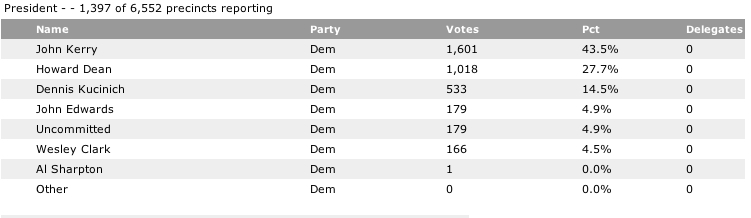
The previous CNN batch of numbers was only up for a couple of minutes, before they were replaced by this next set of numbers. Notice that these numbers still have little relation to the AP numbers, and Kucinich's numbers are still low. This set of numbers with Kerry at 50% is the one that was reported in all the articles and repeated ad infinitum by Fox News. Note that they say 32% precincts are reporting.
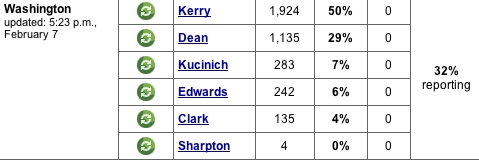
Here is where it gets stranger - soon at 2:31 PST, the AP released new numbers, with 2248 precincts reporting, later revised to be 2125 precincts reporting. This has more precincts reporting than the above CNN/Fox numbers, but Kerry has less delegates, and his delegates are more in line with all the other AP numbers. Also note that Kucinich is still up in the 500 range - also consistent with the AP numbers, but in conflict with Fox and CNN.
This makes me curious about what the heck was up with that set of numbers that Fox/CNN was reporting, of Kerry at 50% with 1924 delegates - which was the set of numbers reflected in the wire articles. They don't even appear to be based in reality, even when these were the numbers reported all over the news.
The revision from 2248 precincts reporting to 2125 precincts reporting:
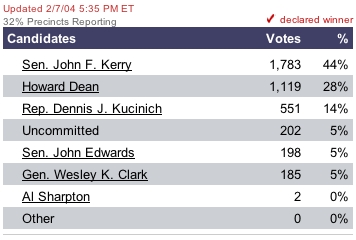
At 2:49, CNN finally revised their numbers. The Kerry@50% numbers were at 32% reporting, while these are at 34% reporting. Note that Kerry's numbers are revised downward, significantly. Why were Kerry's numbers inflated for the set of numbers that all the news articles talked about?
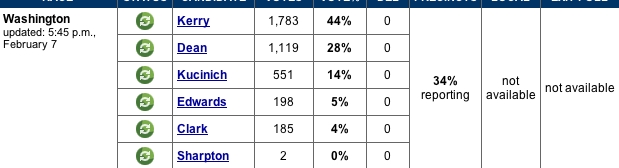
Note that as of 2:54, Fox was still referring to the other set of 34%-reporting numbers that had Kerry at 50%.
Soon, at 2:58, CNN updated their numbers again. While everyone else's numbers grow significantly, Kucinich's numbers are again revised downward, which again, is weird.
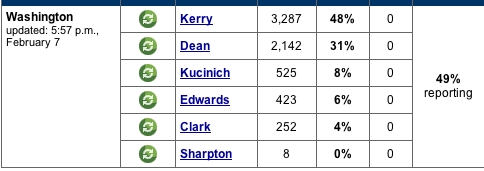
Things start progressing more regularly from this point. At 3:22, 55% (3588) are reporting.
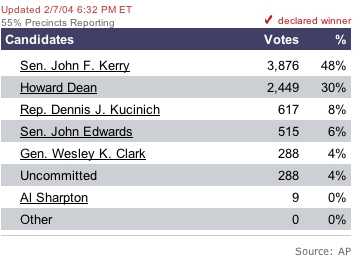
CNN, WaPo, and AP project Kerry at 3:43.
At 4:20, all three sources release numbers from 71% precincts (4624) reporting:
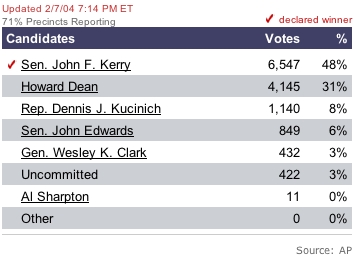
Additionally, the AP has a first draft of delegates apportioned - this is not the complete slate of delegates, but perhaps only from certain congressional districts:
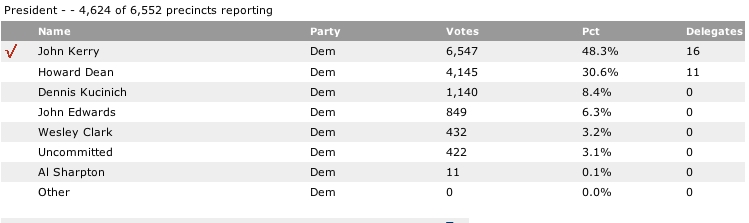
From this point on, they grew basically proportionally until the latest results, 97% reporting:
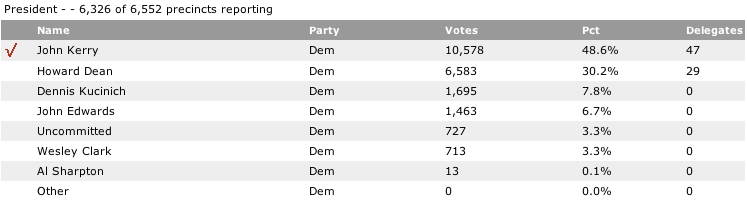
So here are my questions. For someone like me who doesn't work in the Secretary Of State's office, I would expect that once a number is received from the precinct, it is vetted before it is released to the AP. And when 500 precincts are reported, I'd expect that all candidates' delegates should grow or at the very worst, remain the same, when 1000 precincts are reported. Instead, we're seeing a lot of examples of delegates going down. So most of my questions concern where the errors are happening. Do we know that certain precincts vastly misreported their delegate count? Who is it that has the power to revise the numbers? How could Kucinich's numbers have sunk by over three hundred delegates when each precinct didn't have more than twenty or thirty delegates to award? Could that many precincts have been wrong all at the same time?
But my bigger question is, where's the opportunity for monkey business? How do we know there isn't any cheating going on here? I'm a programmer that has to deal with security issues on a daily basis, and I know that security isn't just about monitoring the entry and exit points - you have to be vigilant at every step along the way. When a precinct captain calls in their numbers, how do we know that the other end is recording those numbers? When the precinct captain goes home, they can't trace it back in reverse. Where's the list that shows exactly how many delegates each precinct got, and how that adds up to the total, so every precinct captain can then refer to the same document and verify that that was their total? I heard that in other states, this information is not published because the parties want to keep that demographic information private from other political parties. If that is so, it is definitely opportunity for fraud through obfuscation.
I am not alleging fraud, or even opportunity for fraud, because I honestly don't know enough about how it works to point out the opportunity. But it did strike me as weird that there was so much downward revision of delegate numbers after they had already been reported.
Update:
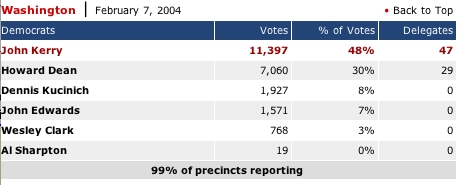
This is with 99% precincts reporting. Note that there are still over 4,000 delegates left to be awarded out of 27,000. There are 55 precincts left to report. Remember that there is an average of four delegates per precinct. What is it that is up with the remaining precincts? What are the chances that only 55 remaining precincts - with 4,000 delegates between them - would mirror the percentage split of candidates that has already been reported?
February 03, 2004
More Diebold Strangeness
explodedview: Kerry Beat Dean in New Hampshire by Only 1.5% When Computers Weren’t Doing the Counting:There very well could be (and probably are) normal explanations for this, but this is the problem with Diebold, is that you don't know for sure, and there isn't reason to trust them.
February 02, 2004
More Diebold Weirdness
Eschaton has a post about the latest example of Diebold voting machine weirdness. And they call us conspiracy theorists! God, I hate how this sort of thing is so hard to bring awareness too. You just want to shake the country by the shoulders and scream, "What are you thinking?!" Idiots. Idiots.January 20, 2004
Yet More Iowa Analysis
After sleeping on it, I believe Iowa came down to two main ingredients.First was the wildcard of Dean's supporters. No one knew how well the polls represented them. Were they a small number of very activist supporters - narrow, but deep? Were they the only visible parts of a vast army? No one knew the answers to this, so the press and pundits felt an excuse to dismiss many of the polls. This is why Dean's finish was considered such a disappointment even when he wasn't in the lead in any poll beforehand. It turned out that Dean was relatively popular, but the supporters were inexperienced, so were unable to effectively horse-trade at the caucuses.
Second was the nature of caucuses. I saw a study that looked at a hypothetical caucus. Say you have four candidates, each with equal support. You need 15% to be viable, but every precinct has only 59 delegates, which mean only the top three for that precinct become viable - essentially random which one that would be.
It comes down to second choices. Two of the candidates have supporters that hate each other and never choose each other as second choice. The other two candidates have second choices evenly distributed.
The end result is that the two candidates that hate each other would end up with 17% apiece, while the other two would end up with 33% apiece - even though they came in with equal support.
A version of this is essentially what happened. Dean and Gephardt went negative on each other. Kerry and Edwards either stayed positive, or in Kerry's case, acted like they were positive.
Combine this with the deal that Edwards and Kucinich had - where if they weren't viable they'd go to the other guy - and you've basically got the caucus. The nature of the caucus basically multiplied the effect of all the negative coverage that happened to Dean. I don't believe that Dean's statewide support is only 18% though.
January 18, 2004
Iowa Caucus
So, tomorrow is the big day - the Iowa caucus, the first state to go on record for who should be the Democratic nominee to beat Bush.The history is that Gephardt led for a long time, and then Dean started his letter-writing campaign. Right around the Gore endorsement, Dean had a huge leap and led convincingly. Kerry was tanking in New Hampshire and decided to focus his efforts on Iowa, and has experienced a resurgence. Edwards campaign has had a resurgence also, but since he's supposed to be strong in the South, his campaign wouldn't be judged to be doomed if he came in third or fourth in Iowa.
All the late polls show everyone bunched up together, with Kerry having a lead. It looked like Dean was losing support midweek, even being in third place for a time, but has since built up support again and is now a close second.
Now, these are the polls. And that's where it starts to fall apart.
Most polls are done by focusing on probable and likely voters. And here's the key - they all make judgments on who these voters are - previous caucus attenders, registered Democrats that obviously have registered long enough ago that the polls know who they are. The assumption - the idiotic, ignorant assumption - that the press keeps on making in their headlines is that Iowa's population as a whole will vote in a way that relates to how they voted four years ago.
So the obvious question is... why wouldn't this be true? How is 2004 different than 2000?
Dean. Dean. Dean. Dean. Dean.
Dean has spent months writing letters to undecided voters. Close to 300,000 of them. Record turnout in the Iowa caucuses is 120,000. The polls focus on past caucus voters. Dean's lists - both for letter-writing, and for the huge vote-canvassing drive he's organized for out-of-state visitors - is from the Secretary Of State's voter rolls, both Democrats and Independents.
There's one more statistic here. Campaigns rate their voters on a one-to-five scale. Ones are those that have communicated to the campaign that they are definitely going to vote for their guy.
The Dean campaign let slip that 60-65% of their Ones are people that have not caucused before.
There are many ratios we do not know here. We do not know what a "normal" percentage of new caucus goers is. But we do know that 60-65% made serious buzz in Iowa. But the implication of these polls is that there is a ratio of predictable voters (past history) to new voters, and that this ratio will be the same for all candidates.
We already know this to be untrue in Dean's case. We already know that Dean will outperform his polling numbers, and we already know that the polls are not attempting to take this into account.
We know that the record caucus turnout is 120k. We know that Gephardt is saying that his Ones numbers 35k in number. We know that Dean is saying that his Ones number between 40k and 50k. And we know that they are polling around 20% apiece.
I think we are in for a huge surprise tomorrow night. I hate predictions because it's so easy to look like an idiot later, but I think Dean is going to win convincingly. My prediction over at dailykos is:
- Dean 36%
- Gep 24%
- Ker 22%
- Edw 19%
- Gep 24%
January 11, 2004
Edwards Gaining In Iowa
Edwards is my second choice candidate. He passed Clark a long time ago as my distrust for Clark built.Edwards is evidently gaining quickly in Iowa, and today Iowa's largest paper endorsed him. Right now Dean leads Gephardt, there's a gap, and then Kerry is in third, with Edwards closing in.
I think this is bad for Dean, because Kerry's strategy would change from trying to overtake Gephardt, to fending off Edwards. This frees Gephardt up to focus on Dean.
The caucus math is really interesting in Iowa because voters show up, but if their first choice doesn't look like they'll reach 15% - on a precinct level - then they go to their next choice, until everyone is supporting someone who's over the 15% mark.
I think this might actually be an advantage to Dean because he's been campaigning over the entire state rather than focusing on particular regions.
January 06, 2004
Voting UI
This is a brainstormed mockup of a voting UI. It's a roughdraft. (Click for a larger picture.)
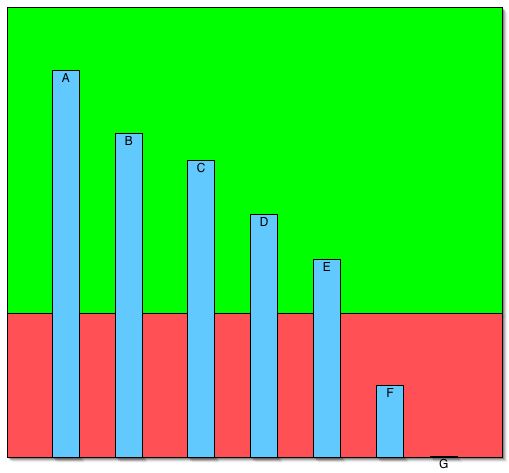
Basically each candidate is a column that you can pull up for more support or down for less support (or no support, as with G). The vertical scale can be seen as the most support the voter can give, to the least support the voter can give. That line that separates red from green would be the line of neutrality. Any candidate above the line is a candidate they want, and below the line a candidate they don't want. The voter could even pull the line higher up if they wanted more room to disapprove of all the candidates, or lower down if they want more room to approve the candidates.
The votes could be recorded within a 100 point range, with the line of neutrality always being zero.
Analyzing the votes is an entirely different matter. So far I haven't found a way to calculate intensity of support that actually works well. So this UI could just be a way to help a voter feel like they are being listened to, until the counting system just reverts to Condorcet. heh.
Voting Methods
I'm once again thinking about voting methods.I've managed to further narrow down people's resistance to certain voting styles. Mainly, when there are situations where someone has a lot of first place votes, but someone else with broader consensus support, they are uncomfortable with the first person losing.
It's like they believe that the first candidate should get a "bonus" for the first place votes.
The reason they think that first place should get a bonus is because they imagine their own preferences. Usually when you have a first choice, it's because you don't care as much about the placement of the other choices.
In other words, imagine this hypothetical set of preferences:
Dean
Yes..x....................................No
Clark
Yes..................x....................No
Edwards
Yes......................x................No
Gephardt
Yes...........................x...........No
Lieberman
Yes...................................x...No
There's a bigger gap between the first choice and any of the other choices.
Here is where I want to point out to Abstract Person, however, that the gap is there because the voter wants it to be there. Not because there is some general rule that first place should always get a bonus.
What happens if someone is torn between their first two choices or only prefers one by a little bit, but knows they want either more than any of the other candidates? Giving a bonus to first choice and nowhere else would disenfranchise their preferences.
So I think the first-place bonus concept is a load of hooey. But, it brings up a lot of thinking about "intensity of preference".
November 20, 2003
Republicans back H.R. 2239
Wired News: Republicans Back E-Vote BillThis is great news. Hopefully this will spur some real bipartisan momentum.
November 17, 2003
Electoral College
Daily Kos || Keep The Electoral CollegeI posted an article over at dailykos.com about the electoral college... it's generating some good discussion. Most of it spurred by me expressing disbelief that other people don't agree with me. :-)
October 27, 2003
Same-Day Registration
H.R. 3153 is a bill that would require states to allow their citizens to register to vote on the same day that the vote is held.
Bob Ney's Objections
Salon.com | Joe Conason's JournalMore press about black box voting. This one again makes the point of how Bob Ney is standing in the way of Holt's legislation to require a paper trail for electronic voting.
Florida 2000 and Diebold
Scoop: Diebold Memos Disclose Florida 2000 E-Voting FraudVery nice in-depth look at how electronic ballot flaws were a much bigger impact on the Florida 2000 elections than hanging chads ever were.
MSNBC Covers Voting Fraud
Black Box Voting BluesCritics of verifiable voting do have a point when they note that the printouts are susceptible to some of the same kinds of tricks once played with paper ballots.
Good article, but he does have to make reference to this point that I've never seen explained anywhere. The point I've always seen made is about the flaws that come up for voter receipts that voters take with them. I don't know of a flaw for the kind of paper trail where the printout is turned in at the ballot station.
October 01, 2003
Free State Project Chooses State
Libertarians aim to set N.H. freeI've written about the Free State Project before - it's a project to recruit 20,000 people to all move to a state together, so as to change the political makeup of the state (they are Libertarian). Also notable is that they used Condorcet voting to pick the state. This was a perfect choice for what they wanted - finding the broadest consensus for a state.
Voting Standards
Salon.com Technology | Another case of electronic vote-tampering?Controversy about setting voting standards from with the IEEE. What makes this interesting is that the article implies a "call-to-arms" for all computer scientists interested in voting standards to join the working group, so as to force the industry insiders to make room for their concerns.
September 30, 2003
Maximize Affirmed Majorities
The MAXIMIZE AFFIRMED MAJORITIES voting procedureHere's a voting method that seems to be superior even to Condorcet and Ranked Pairs.
I don't understand the definition, but it's similar to both and seems right in line with what Marquis Condorcet intended from the beginning.
September 23, 2003
Bev Harris Interview
Salon.com Technology | An open invitation to election fraudAn interview with the author of the upcoming book, "Black Box Voting". When is the book going to come out, already??
September 04, 2003
Diebold Vote Tracking
Slashdot | Electronic Voting: Your Worst Nightmares are TrueHot damn. They uncovered evidence that Diebold machines were reporting election results wirelessly, over a network, while people were voting. This could mean that the votes can be manipulated in real time.
Any district considering Diebold machines should stop now. Any district should only consider voting machines with a voter-verifiable paper-trail. And any voter should check status on the paper-trail voting bill in Congress, sponsored by the democrat from New Jersey. Holst or something?
August 11, 2003
More On Voting Machines
Jolted Over Electronic Voting (washingtonpost.com)People are slowly (but too slowly) paying attention to the vote machine reports.
August 04, 2003
Harris and Florida
GRAND THEFT AMERICAHere's a pretty dramatic presentation about Florida's disenfranchisement of voters in 2000.
July 24, 2003
Diebold Flaws
E-voting flaws risk ballot fraudThis is huge news. This whole subject has been buzzing along on the grass-roots level for a while, but here it broke through to the media including the New York Times. This also came from the internet - it was one of those sites that everyone writes off as a conspiracy site that made the source code available, these scientists grabbed and analyzed the source code. A huge win for the internet.
June 26, 2003
Potential Washington Vote Fraud
Washington State is attempting to ram through a voting bill that allows electronic voting machines with no paper trail. This is bad, bad, bad. Tomorrow is the last day for public comment on this matter. Here is an informational article on the matter. Here is the page that has info on how to comment. This is what I emailed to them:You must, must, must include a voter verifiable paper trail in any electronic voting system. Democracy is invalid if the citizens don't trust the democratic process. Voting is how citizens voice their power. Citizens cannot trust democracy if they can't verify their power. Asking citizens to rely on government to trust government-appointed analysts is circular thinking, and is not sufficient; the point is to allow the CITIZENS to verify the process.Update: - Nice, they wrote me back and told me my comments would be included as part of the public record for this issue. I'm not sure exactly what that means, but at least it increases the likelihood that it would actually be read when it matters...You must protect against any appearance of impropriety. A black box voting process where we cannot see the workings has the appearance of impropriety. Do not support any effort that does not allow a voter-verifiable paper trail and does not allow for random sampling to check results.
June 05, 2003
Voting Reform Bill!
Congressman Rush Holt WebsiteYippee!!!! This is awesome!!! EVERYONE should actively support this bill!
May 23, 2003
Free State and Condorcet
Voting Methods Report for the Free State ProjectThe Free State Project is an organization that is seeking to gain a critical mass of 20,000 people to all move to a low population state in an effort to reshape that state's political reality. They are libertarian. To choose their state, they have recently decided to use the Condorcet method. This voting methods report is notable because it has some new opinions that I haven't seen before, including Saari's admission that Borda is flawed to strategic voting.
May 16, 2003
Voting Blues
110702otterThere's a general article pointing to all sorts of writings about vote fraud, some more conspiratorial than others.
That said, I think that it's worthwhile to always strongly oppose any electronic voting system that does not have a verifiable paper trail.
On the other hand, this doesn't concern me so much on a personal level, because I live in Oregon, and we don't have electronic voting machines because we only do vote by mail! Woo-hoo!
April 28, 2003
IRV contradiction
Election Selection: Science News Online, Nov. 2, 2002I'm sure I've blogged about this before, but I just wanted to hilight the scenario of Instant Runoff Voting where someone who would normally come in first can convince more people to vote for him, leading to him coming in last.
Whatever its potential benefits, instant-runoff voting is prone to one of voting theory's most bewildering paradoxes. If a candidate is in the lead during an election season, making a great speech that attracts even more supporters to his cause shouldn't make him lose. But in the instant-runoff system, it can. Suppose, for example, that 35 percent of voters prefer A first, B second, and C third; 33 percent prefer B first, C second, and A third; and 32 percent prefer C first, A second, and B third. In an instant runoff, C will be eliminated, leaving A and B to face each other. A scoops up C's first-place votes, winning a resounding 67 percent to 33 percent victory over B. But suppose A makes such an inspiring speech that some voters who liked B best move A into first place, so now 37 percent rank the candidates as A-B-C, 31 percent as B-C-A, and 32 percent as C-A-B. Now, A faces C in the runoff, not B. The votes that ranked B first become votes for C, and C beats A, 63 percent to 37 percent.
April 27, 2003
Approval Strategy
Here's a good quote I found from an old article over at kuro5hin.org. It clearly describes a strategy problem with Approval Voting.
Let's say your preference is Green over Democrat and Democrat over Republican. Under approval voting, I should vote for Nader and Gore. But what if the Green Party slowly turns into a major party while the Republicans decline? Voting for both Democrat and Green makes sense only if the Republican has a chance of winning. Once the Republican slips in popularity, then you are faced with dilemma of, "When should I stop voting for the Democrat?" Wait too long, you might help Gore beat Nader. If you commit too soon to Nader, you might help Bush beat Gore.
April 18, 2003
More Voting Ideas
The voting thing has stuck with me and now I think I've got a path again. For those of you who have been reading for a while, I had been spending a lot of energy to research various voting methods, and then I finally reached a point where I felt stuck.I felt stuck because I realized that if we reached a point where we were able to interpret society's desires exactly... would we really want to? I mean, when you've got 49.9% of the people out there with below average intelligence.... that's kind of depressing. :-)
But then, I kept it cooking in the back of my head. And I found a few more things that slowly started to get me unstuck, and one of them was Deliberative Polling. When you can educate the voting population, their votes start to change. And if we make the assumption that an informed voting population is a better voting population, then those changes in voting are good changes.
So then it becomes a matter of combining the voting process with the education process. And how do you do that?
Well in my mind, it's combining full representation with the ability of the representatives to present all the varying views, and then working to reach consensus.
So, stirring that together with some other ideas I've come across, here's the sketch of the latest solution I have in mind, along with a couple of sticking points.
First, I'm a big fan of direct representation. One of the things I've always loved about the internet is that it allows you to find people that might share very distinctive interests with you, from all around the country. It always felt wrong that if some of these interests might be political, that they might be able to be represented if all these people happened to live in one county, but if they didn't, they couldn't be represented. I feel there has to be a nongeographical element in our government if we're going to be represented; otherwise interests that are nonregional in nature are in danger of being swallowed up by regional interests.
Direct representation works by a voter being able to pick any candidate to represent themselves. Everyone picks a representative, and then the votes are held, and if there are 100 slots in the legislative body, then the 100 most popular reps are elected. Usually this is implemented so that each rep is given proportional power, but that wouldn't be true in this case.
There are sticking points in that controls would have to be introduced so that different candidates would be ensured to be materially different in belief from each other. Otherwise a bunch of very similar yet popular candidates could run and squeeze out other less popular but more representative candidates.
But through using a similar process, it should be possible to put together a decision-making group that more accurately represents the voting population.
Second, the decision-making group then only passes initiatives that have unanimous approval, using a very aggressive process that combines structured discussions, education, and isolation of key points. Initiatives are broken apart into component sections that are individually passed to find consensus, and any dissenting point of view that is expressed is brought into the process in an attempt to be reconciled.
So the representative's votes may change than that of his or her voting population's, but this would be because of the education and discussion. Reports would be sent back to the voters so the voters could decide whether to stay with their representative or move on to someone else.
April 03, 2003
Legislatures and Sessions
Well, it looks like the basic nut is that Oregon State Law doesn't specifically disallow preference voting, but that state election officials are unwilling to say these voting methods are allowed because state law doesn't explicitly allow them.There was a lot of work done on this in 2001 and 2002 with a recommendation that a law be passed in the 2003 session, but no one got around to lobbying the legislature. My rep says it is too late to introduce in the 2003 session, which convened in January. Sessions last about six months and are biennial.
Which is a bummer because while I don't know much about it yet, it looks like the next chance to clarify this would be in 2005, for passage on 1/1/2006. I don't see the point; by then Saddam Hussein will be president and IRV will be the last thing on our minds. ;-)
April 02, 2003
Vote Reform Status
So I had some email activity about vote reform today. Evidently there were two efforts to pass IRV in Oregon recently, one statewide through an initiative process, and another in Eugene for city council.The initiative process bogged down for unclear reasons. I wrote some leaders at the Center For Voting And Democracy and they said that after some bad experiences they think that lobbying is a much more constructive approach than the initiative process. That aligns with a gut impression I had. I also found information on Vancouver WA's recent success in passing their IRV measure - while it merely allowed IRV as an option, didn't require anything, and didn't cost any funds, it still only passed 52-48. There's just a lot of lazy distrust out there.
The rest of the clues so far are coming from details emerging on the Eugene effort. I was forwarded part of OR's constitution that specifically details majority voting but also allows preference voting given the passage of laws allowing them. That's how I read it anyway - it's not against the constitution, but would require further law. Complicating this is the murmuring that the Secretary Of State plays a hand in this in terms of deciding whether or not to allow different voting methods. I don't know what that's all about yet.
Finally, there's been some chatter about superior voting methods. Right now I'm leaning towards Approval. I think Condorcet is better, but Approval is simpler, easier to explain, easier to implement. I'm getting feedback from others about how Approval is harder to sell than IRV. Here's a quote from a member of CVD:
It has one major flaw that comes up in the real world of elections: your second choice candidate can defeat your first choice candidate if you decide to approve of both of them. The end result is a whole lot of bullet voting and voter perceptions of something fishy going on. Politcally, it can be hard to defend it when something who could have more than 50% in our current plurality system, but lose under approval voting.Good points. I personally believe they fall apart given that I believe a consensus candidate should beat out a 51% candidate, but that's a philosophical issue that people don't usually even think about.
More as it happens...
Taking Action
I've been asked a few times how to translate emotion into action, in the context of my War Position.Some of it is my personal beliefs. I believe that physically expressing your emotions "until you are done" (and not just until you feel silly) is part of it, and that going through the workout can open you up to insights you might not have had before.
But on a more systematic level, I believe it's basically a matter of questioning your accepted reality until you no longer feel you are compromising yourself. If I'm asked how long I think the UN inspections should go before we're entitled to go to war, I know just from how I feel that it's a false question. So I take it a step backwards. "Who says failed inspections should lead to war?" Okay, then what should failed inspections lead to? The question still feels off, feels like answering the question on its own terms would be accepting something that I don't actually agree with. Step back. "But, the criteria for whether UN inspections are effective don't make any sense in the first place." Okay, then how would you judge whether UN inspections are effective? Still feels crappy. Step back. "How the hell do UN inspections even bring us closer to our objectives anyway? I don't believe they do." Well, then what do you think should happen to bring us closer to our objectives? Wait a second, still crappy: "What the hell are our objectives, anyway? They're not even consistent!" What do you need to feel like our objectives are consistent? And then we're getting somewhere.
See, it's a big snarl. We lose the battle because we get exhausted and give in before we untangle it.
So, how do we stop that? We stop fucking around and we work harder to stop compromising ourselves. I am not under the illusions that we all have the same points in ourselves where we feel like we are compromising ourselves. Everyone's process is different. But I firmly believe that way too many of us are being lazy in our integrity and are compromising ourselves all over the place. It's an individual battle. Our emotions give us clues and tell us when we feel like we're compromising ourselves. We need to listen to those emotions, we need to be dogged, and we need to vigilant in recognizing the various forces in life that lull us into ignoring ourselves, so we can get pissed off enough at them to battle them.
You start small, just by telling yourself to notice when you feel like you're compromising. You just challenge it one step further than you did before to isolate the parts that feel good from the parts that don't. You just promise yourself to insist on yourself a little bit more every day. That's how you do it.
They say that politics is the art of compromise. I think that's true, but it has a more insidious meaning to me than it does to most other people.
If you think about what I've been writing about Gore/Nader and the voting problem, you'll see an example of this applied. Asking "Gore or Nader?" is just a question that feels shitty to me. I'm not interested in that question existing in my world, so I work to remove it.
April 01, 2003
Voting Reform
Well, it looks like I am starting to enter back into my "voting methods" phase. With election season starting, I of course trace back my own various discomforts to where I feel like the roots are, and my discomfort with voting is that voters are often asked to compromise themselves to protect their preferences. This makes no emotional sense to me, and leads to vote outcomes being determined by the idiosyncracies of a voting system rather than the actual will of the voters.If you search on my blog, you will find a long thread of entries having to do with various voting methods. I ended up with the conclusion that in our current form of democracy, it's essential that in multi-candidate races we have the ability to communicate preferences or multiple options. There are various voting methods that allow this.
So, last night I wrote my state representative about it. I had found out that there's an Oregon state law that disallows alternative voting systems and had questions about how to overturn it. He wrote me back today and said that he would like to get together between sessions to talk further about it, and that he could potentially help me get the ideas presented to the state House.
So now I feel like I really have to learn a lot about local and state government to know what to actually ask for! It might be enough to ask the state to merely remove the restriction, but on the other hand that might not do any good if it's a requirement on the state level that everyone follow the same voting method. I'm not sure where to look yet... it's probably a question for the Secretary Of State's office.
March 08, 2003
Deliberative Polling
Deliberative Polling is a method to show what happens to people's views after they have a chance to educate themselves on the issues, often through interaction with other participants of the polls.The executive summary is interesting - especially the part about British voting intention. Conservative and Labor both went down, while Liberal went up by 22%.
There's also a summary of a Deliberative Poll held between January 11th and 13th of this year, which is very topical. Lots of stuff about Iraq. In general everyone became more multilateral through the exercise.
A very convincing project overall.
February 25, 2003
Too Many Ideas
Life can feel like it sucks when you have too many ideas to even keep in your head at one time. Sure, it's exciting on the outside, but on the inside you can just feel like you are treading water while exhausted, scrambling to evolve rather than stagnate.As I get older, I find that my overall theme of technical interest is getting more focused, but as I delve deeper I also find more people, many of whom are younger than me, even more intensely into it and more productive than I am.
Most simply and abstractly put, it's about empowering the mob without having the mob mentality. Finding group opinions without risking groupthink. Aggregating public opinion without ignoring individual inspiration. Interpreting group preferences, encouraging group creativity, decentralizing group productivity. All these topics spin in my head and they are so easily interrelated, so exciting, so overwhelming, so paralyzing.
Just in the last few days I found all of Joi Ito's writings on Emergent Democracy, and also something of a low-key job offer to work on collaborative filtering technology with someone who owns a bunch of patents on it, and there's so much to consider.
I want to feel like I'm a delver rather than a scanner, but the deeper I go, more I feel like I've only begun to scratch the surface. How much harder do I have to work before I actually feel like I'm moving forward?
December 01, 2002
Why Do We Vote, Again?
So, here's where I'm at on the group-voting/social-choice thing.
- My own interest behind this is researching what it would take to have the government represent the people's views as closely as possible
- To fix the counting of single-winner elections, a stable counting method is required, which is what got me looking at IRV versus Condorcet versus Borda versus Approval, etc.
- Even if a a stable counting method is found, a vote can still be flawed if all participating voters do not equally feel they have an available candidate that represents their views. This begs the question of how to increase the pool of candidates.
- Even if the candidate pool is "perfect" as described in #3, there is a point where picking a single-winner to represent all people among a geographical district just doesn't make sense, which leads to my curiosity of multiple-winner elections and representation, such as direct representation (where people can just choose their assigned representative regardless of geography and assign their vote/pledge to them).
- Even if direct representatives are elected, there is the matter of how that body of representatives will come to decisions among themselves (which might take us right back through steps 1 through 4)
- And finally, even if we did end up having a government-counting solution that represented the public's views EXACTLY, it begs the question of if that is what we really even want? To a point I agree with the philosophy that a representative is actually a compromise between what the public thinks it wants, and what the representative knows the public needs due to inside knowledge the public wouldn't have the patience to learn! In other words, if we all had the power to actually assign where in the government expenditures all our tax dollars would go, I just can't help but believe we'd be in an extraordinarily huge mess.
In terms of single-winner voting, I'm still mulling over the interface. There are a lot of things to consider, like whether to force users to rank every candidate, whether to let them specify a cut-off point, above which is only the candidates they would really like to win, and whether to let them specify another cut-off point, below which are the candidates they really hate...
November 17, 2002
IRV Rebuttal
Cal IRV FAQ - Here is a page that shows a voting scenario about how IRV is superior to Condorcet (pairwise) voting. They show a voting scenario that seems mostly reasonable, based in history, of Reagan facing Carter facing Anderson. In their scenario, IRV means Regan wins, while in Condorcet, Anderson wins.It's distracting because their stats aren't exactly what happened in that election. But, because of history and the names, it seems right that Reagan should win, and just weird that Anderson should win. Especially since we have this history of feeling dominated by the two major parties, and with Anderson being an independent.
So I will redraw the scenario here. Same stats, same candidate make-up. But without the names:
| Votes | 1st | 2nd | 3rd |
| 48 | |||
| 47 | |||
| 4 | |||
| 1 |
That's better. IRV: Red wins. Condorcet: Yellow wins.
This one is interesting because at first glance it certainly does seem as if either red or blue should win. If you look at first-place votes, red and blue are way ahead of yellow. The most damaging argument against Yellow is that 95% of the voters don't even want Yellow as their first choice.
But if we look at the rankings, it's not that simple. Third place here doesn't just mean a good show like in a horse race, it means last. The people that voted red first really don't want blue to win, and vice versa. In fact, we can tell that if either red or blue is voted in, around half of the voters will be very unhappy.
So what is the goal of a vote? Is it to make a horse race with a dramatic finish where you can either win big or be crushed? Or is it to capture the collective consensus of the entire voting population?
If it's consensus, then I believe Yellow is the winner. 100% of the voters ranked Yellow either first or second. No one hates Yellow. 52% of the voters hate Blue. 48% hate Red. Neither would well represent the entire population. And Yellow would. No one voted only for Red (or Blue) with no other choices - all are indicating they'd accept Yellow as a second choice. Yellow reflects the consensus choice of the voters.
Voting systems are eventually dependent upon subjective preferences of the people advocating them. If the goal is to focus mostly on plurality-style counting, only looking at preferences if the outcome is in doubt, and if the goal is to put as much weight as possible on the 1st-choice candidates and risking having your preferences ignored if support the wrong candidate, then IRV is the right voting system. But if the goal is to have all your preferences paid attention to in the counting, and if the goal is to find the consensus choice of the entire group, Condorcet (pairwise) would be the better choice.
November 12, 2002
Irrelevant Alternatives
A supplementary realization on the "Indepences of Irrelevant Alternatives Criteria" (IIAC) example below.Condorcet only "flunks" this criteria IF the vote ends up in a cycle. Meaning, if:
- The majority prefers A over B
- The majority prefers B over C
- The majority prefers C over A
The other voting methods can flunk IIAC, however, even if there isn't a cycle.
In the example below, I make the argument that it's fair for that scenario.
However, the Gore/Bush/Nader election did not have a cycle. The majority in Florida probably preferred Gore over Bush, and also Gore over Nader.
Plurality voting flunked there. Condorcet would not have.
Soon, I will be finished looking into and understanding all the different voting methods, and will begin implementing them into a voting application I am writing.
I am rapidly understanding that finding the correct vote-counting procedure will only take you so far. Because using a vote-counting system to find the perfect social choice depends on one thing - each participant of that vote feeling they have a perfect candidate to vote on. Or at least, each voter being equally satisfied that their candidate reflects their choice. And that's far from the truth.
And so with that, here is my summary of the different voting systems I have researched:
- Plurality: Most first-place votes wins.
- Approval: Vote for as many candidates as you want. Candidate with most votes wins. This is widely recognized as a solid counting system. I personally feel it can give too much false power to a compromise candidate, though.
- IRV: If no first-ranked candidate gets a majority (>50%), delete worst first-rank, bump up second rank for those ballots, refigure. Repeat as necessary. There are many, many flaws for IRV.
- Borda: For a five-candidate election, rank all five. 1st place gets 5 points, 2nd place gets 4 points, etc. Most points win. Technically solid, but high chance of voters voting insincerely for strategic reasons.
- Condorcet: Head-to-head cage matches. Winner beats all other candidates. If there's a cycle, it gets complicated.
- Ranked Pairs: Similar to Condorcet. I don't understand it yet.
November 10, 2002
When We Settle
Here's the scenario that is most aggravating about all voting theory:Say you have a vote with candidate A and candidate C, and it would end up:
40 A
60 C
C wins. But now say that B enters the race. And for various reasons, the new preference makeup is like this:
40 A B C
35 B C A
25 C A B
The thinking goes, to be REALLY fair, if C would have normally beat A, and you're introducing a candidate that wouldn't win, shouldn't C still beat A?
It seems obvious, doesn't it? This is one of the main requirements that Kenneth Arrow described for "fair voting", which he then proved could never happen.
And it looks like in each of our voting systems, it flunks in one way or another:
- Approval: (Irrelevant in this case)
- Plurality: A now wins with 40% of the vote
- IRV: C is eliminated first, A then wins
- Borda: A now wins with 40% of the awarded points
- Condorcet: This one's interesting - by listing the
head-to-head matchups in order, we get:
B/C: 75-25
A/B: 65-35
C/A: 60-40And that's a cycle. Condorcet has various methods of breaking these tie votes, some by strength of victory (B/C would be 75), others by margin of victory (B/C would be 50). But in all cases, their tie-breaking scenario would eliminate C/A as the weakest win here, which would eliminate C from the tallies, which would once again lead to A winning.
So in all cases, C would have first won, B is introduced, B never wins, and C is now always in last place. Doesn't that just seem wrong?
Well, here's the trick. Maybe it isn't wrong. Maybe that's entirely fair. I (and many others, it turns out) think the whole requirement (it's called the "Irrelevant Alternatives" criteria) is flawed to begin with.
First, it's important to recognize that just because a third candidate may change the order of two other candidates, it doesn't mean that will always happen. But second, it's just as important to consider the emotional dynamics that could create such a vote. Look at the vote results above again. What really happened? Well first, look at relative loyalty. There are the people that preferred A to C, and the people that preferred C to A. The A fans were much more loyal to A than the C fans were to C. The new candidate never bisected the difference between C and A for the C fans, and in many cases they decided they liked B better. C lost power among his base here, while A did not. There was greater strength of passion among the A voters than the C voters. And also, it suggests that the C voters didn't see a huge difference between C and A, while the A voters did. Perhaps A had a very strong regional base that wasn't compromised by B joining in. Perhaps the original C voters was made up of people that weren't strong C voters, but merely a coalition instead, and then the introduction of B busted the coalition. These aren't just maybe-perhaps, they are (IMO) the more likely explanations of what could have enabled this vote. When you start looking at the story behind the number, the results starts to sound a bit more rational. The numbers themselves suggest that of C's original supporters, many of them felt they were compromising.
The other thing is, each candidate is a vote in and of itself. If I'm trying to put a vote in for my favorite film, I'm not voting for the best ending, or the best poignant smile, or the best sunset - I'm weighing it all in my head and picking my favorite, all things considered. And since I'm summing up criterias in my head, I can have cycles amongst *my* preferences just the same as an overall vote could. If I had to consider all my films on a head-to-head basis, I doubt I'd be consistent. I'd pick Fearless over Zoolander because I like its depth. I'd pick Titanic over Fearless because of its sheer majesty. I'd pick Zoolander over Titanic, because comparatively, Titanic exhausts me. Cycles are rational, because when people rank candidates over each other, they aren't one-quality candidates. Each candidate has a collection of qualities that are more important depending upon the matchup. In other words, it's all about the matchup. (Think of college football!!)
So, there are plenty of defenses of how a new candidate can make the tallies turn out that way, and how the tallies can then make the vote turn out that way. The Irrelevant Alternatives criteria is more complicated than it sounds - just because an alternative is introduced and doesn't win does not make that alternative irrelevant.
November 08, 2002
A Voting Summary
I think where I'm ending up on the whole voting thing is:- Borda is the best method if you can assume that everyone votes honestly and rationally.
- You can't assume that everyone votes honestly and rationally.
- I'm still confused between Condorcet and Approval, but Condorcet just seems cooler to me.
I'm still confused on a number of matters, though.
- Condorcet's rankings assume an equidistant preference shift between each choice. #1 is as much a better choice than #2 is for me as #2 is to #3. When really, I might be rabid about #1, while #2 and #3 might just be okay.
- In Borda, #1 has an advantage over #5, five points to one (for five candidates). In Condorcet, it's just scored as a win.
- I want a voting method that will measure how MUCH you want someone over another candidate (degree of rabidness), but without having to deal with all the fear-based voting that could entail (increasing a second-choice candidate means decreasing the likelihood of the first-choice candidate).
November 07, 2002
A Case For Condorcet's Method
A Case For Condorcet's Method - This is one of the better essays I've read on this - it makes some really good thought-provoking points on some of the misguidedness of our Campaign Finance Reforms.Electoral College Defense
I've been doing a lot of reading over at Election Methods, which has a lot of information on Condorcet Voting.It's very convincing. What's interesting, though, is that these people writing against it are as strongly against the Electoral College as they are for these decent voting systems.
And I pretty much disagree with that just as strongly. I like the Electoral College. Part of the reason I like it is because it is nifty, and it's dramatic. I'll ignore those defenses for now. Part of the reason other people like it is because if one state like Florida has major fraud problems, other states are insulated from it, and abolishing the EC would remove that insulation. I think that's a stupid defense. (Tangential explanation: If that's the only reason not to, it means they otherwise agree and it needs to be done, in which case they're just being cowards - suck it up and make it work. If it's not the only reason, there are undoubtedly better reasons than that to focus on, so move on from the fear-based one for the same reason.)
Why do I like the EC? Well, I'd tell you, except that one of my reasons just fell apart in my head while thinking it through, and now I'm not so sure about it. I'll have to get back to you!
November 05, 2002
IRV Isn't All That Great
Here's a good explanation of how IRV is just screwy:Say we have two extremist candidates and a centrist. For instance, say we have Pat Buchanan, Colin Powell, and Ralph Nader.
Now, say people rank them all:
- 5 million people vote only for Powell.
- 8 million left-wing people rank Nader first, Powell second.
- 7 million right-wing people rank Buchanan first, Powell second.
What's common sense? First, could a situation even vaguely similar to this happen? I think so. It's not a ridiculous scenario. Second, just stare at that for a second and tell me who you think should win.
Ok, now look at it this way. 13 million people prefer Powell to Buchanan. 12 million people prefer Powell to Nader. Only 8 million people voted for Nader. Only 7 million people voted for Buchanan. (This is how Condorcet voting looks at things.) Shouldn't Powell win?
If a voting system asks voters to rank candidates, isn't the implication that those rankings should be paid attention to?
IRV voting would eliminate Powell first, since he has the least first-place votes. Nader would win.
Vote Systems Review
Election season has me in a voting sciences mood again.Really fascinating that I am seeing more articles on the Borda Count recently, which some experts says is the only voting method WORSE than our current plurality (most votes win) system.
In Borda Count, you rank candidates. If there are five candidates, your top choice gets five points, second choice gets four points, etc. If everyone votes rationally, it works okay, but there's a big chance for strategic voting as well. Say your rational choice for three candidates, are: A, B, C. But A and B are in a tight race, and C is a longshot. To maximize A's chances, strategically it's better to rank your votes: A, C, B. You've artificially increased the gap between A and B and given A a better chance to win. This is a voting system that asks you to vote against your preference in order to vote your preference.
That's unfair. What do I mean by unfair? Turns out there is an academic definition of unfair in the voting world. Fair voting means that voting your actual preference order should never, never, never, mean that it increases the chances of candidates winning in an order other than your own.
See, there was this guy named Kenneth Arrow. And he proved that for any election of more than two candidates, it is impossible to have a fully fair election. Just flat out impossible. Isn't that depressing?
You think Instant Runoff Voting is the answer? IRV was very popular last election because it eliminates the spoiler effect. This is the other voting method written up in these articles. IRV means that you rank your candidates. Count all the 1st place votes. If no one gets over 50%, take away the lowest vote-getting first-placer, then refigure. Repeat until someone wins. It sounds cool - Nader's votes go to Gore, Gore wins - but there are a lot of demonstrations out there that show how it's possible that ranking someone low will increase their chances of winning and vice versa. And how if there's a competitive three-way race, very strange results can happen. Really weird things can happen with Instant Runoff Voting.
Back to Arrow. It turns out that there is ONE voting method that is extremely, extremely, extremely close to fully fair. And that is Condorcet voting. Here's how it works. Basically, the only truly fair vote is when it's between only two candidates. Everyone votes, winner takes all. Easy. But that's not choice - how do you do that with more candidates? Well, you rank your candidates, and look at it as a bunch of one on one candidates. Rank: A, B, C. That means that A->B, A->C, and B->C. Say someone else ranks B, C, A. That means that B->C, C->A, and B->A. Then you total them all together. A->B: 1. A->C: 1. B->C: 2. etc.
It turns out there is a very solid way of figuring out who wins the election in this method, and if one arguably flawed requirement of Arrow's Theorem is relaxed just a little bit, then it fits all of his criteria for fair voting. Most importantly, there is no need for strategic voting.
Of course, this whole subject only fits for people that actually want their preferences known. What happens when people don't? Like tonight - I know that many people are voting for Measure 23 not because they hope it will pass, but because they are sure it won't, but want it to only fail by a little bit so a better revised version will come out next election. Boy, is that asking for trouble. :) I ended up abstaining from voting on this particular measure (sort of unintentionally, but I think in hindsight that was the best way to go).